
Stop Trying to be so FAANG-tastic
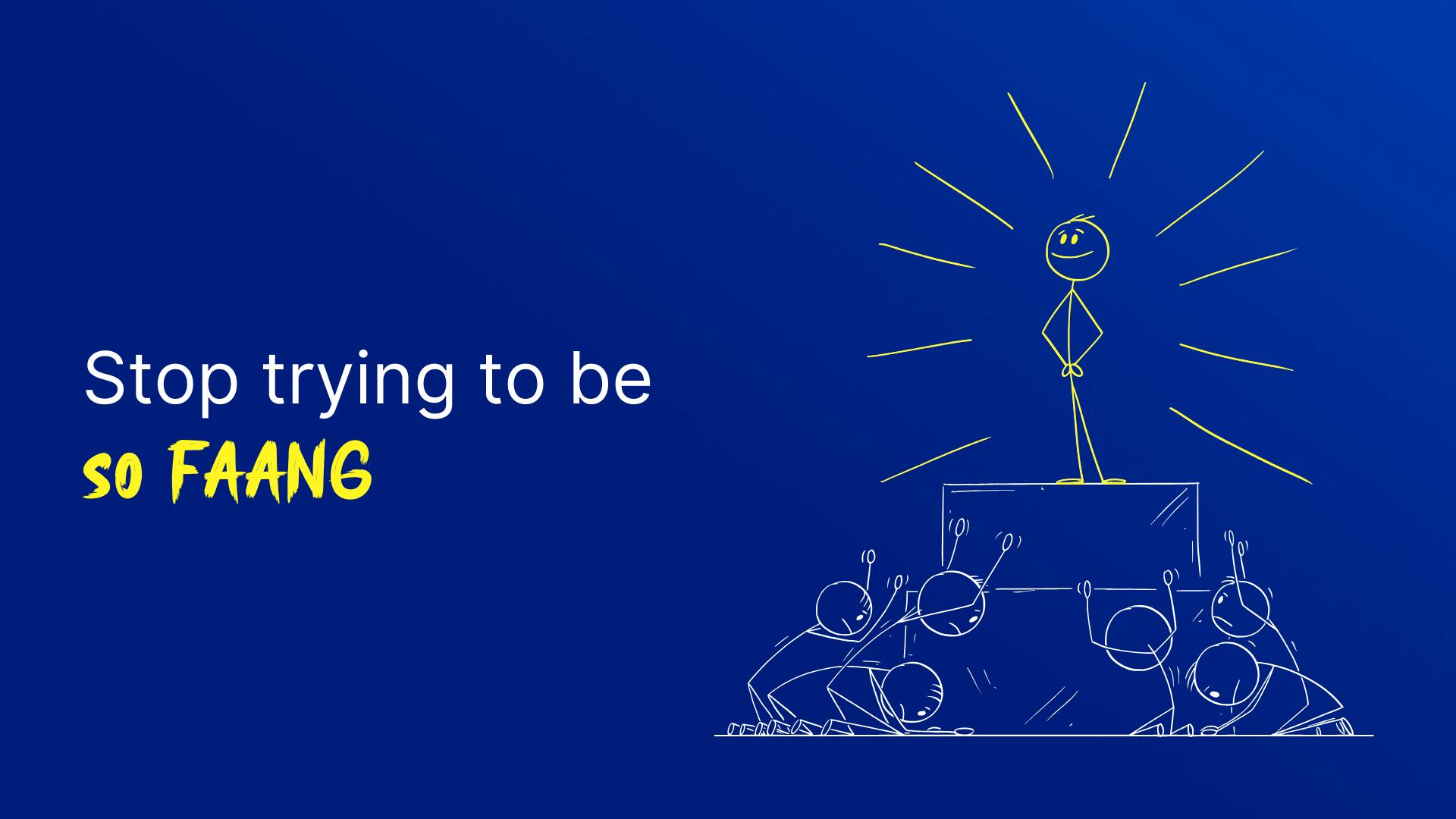
Don't adjust your screens, ladies and gentlemen. This is a post that actually isn't about AI. I know, crazy, right? In a LinkedIn feed that's approximately 94% "how AI will revolutionise [insert literally anything here]," I thought we could talk about something that's been bugging me for a while.
Why are so many companies still trying to be FAANG?
For anyone mercifully sheltered from the acronym - Facebook (now Meta), Apple, Amazon, Netflix, and Google (now Alphabet). The five tech giants that an entire generation of talent and culture teams have been benchmarking against for the best part of 15+ years . The campus offices. The unlimited snack bars. The culture budgets bigger than most companies' entire revenue.
I get it. Ten years ago, I had that same burning desire to work for the Facebooks and Googles of the world. They felt like the pinnacle.
Now? I probably couldn't think of anything worse. Meta's had congressional hearings about data weaponisation. Amazon's warehouse conditions are a permanent news fixture. Most are laying off 000's of people whilst posting record profits year on year. The aspirational brand that looked unbeatable a decade ago now comes with serious baggage. And when you copy someone else's playbook, you copy their vulnerabilities too. You borrow the halo without understanding the shadow it casts.
But the real problem isn't that FAANG's reputation has taken a few hits. It's that companies were (in some cases, still are) copying a playbook that was never designed for them.
The cargo cult problem
There's a concept in anthropology called a cargo cult. During World War II, Pacific Island communities saw military planes delivering supplies to airstrips. After the war, they built replica runways out of straw, hoping the planes would come back. They mimicked the form without understanding the function.
That's what a lot of talent attraction and culture teams are put under pressure to do, even today. See Meta's careers page and build something similar. Read about Netflix's culture deck and write your own version. We went through that phase of companies installing ping pong tables and bean bags because they thought that's what innovative companies did - and most people are wiser to that now. But the EVP messaging and taglines about "changing the world" and "pushing boundaries" from companies that sell accounting software? That's still everywhere.
None of it works. And I think the reason is simple.
FAANG can afford to be generic because they have gravitational pull. Google doesn't need a distinctive EVP. They're Google. The brand recognition, the compensation, the sheer prestige does the heavy lifting. Everyone else needs to actually earn attention. Being bland is a luxury only billion-dollar brands can afford.
Enjoying this? I can pop the next one in your inbox if you'd like.
The Netflix deck everyone misread
The Netflix culture deck is probably the single most copied and most misunderstood piece of culture content created in the last generation. Back in 2009, Hastings and McCord were championing extraordinary candour - even before Kim Scott packaged the concept up into her "care personally, challenge directly, Radical Candour" quadrant model. The keeper test. No formal vacation policy. Pay top of market. Brilliant. For Netflix.
Most companies that tried to copy it ended up with a toxic "perform or you're gone" culture without the compensation to soften the blow. Copying the playbook without the conditions is like copying a Formula 1 pit strategy for your daily commute.
The purveyors of such 'copy cat' decks, I fear, were more interested in ego over impact. They aimed for the glory when they should have targeted grounded reality. You don't need a culture deck that goes viral. You need a culture that actually works for the people in it.
The permission to be normal
Where I think most companies - particularly scale-ups and SMEs - get this properly wrong is the assumption that they need a grand purpose statement. "We're transforming the future of..." whatever. "We're on a mission to change..." something. As if unless you're solving world peace or curing cancer, you've got nothing interesting to say.
That's rubbish.
Most businesses do something useful. Maybe even important. But not world-changing. And that is completely, utterly fine. The dishonesty comes from dressing normal work up as a social movement. A logistics company on a mission to "connect humanity through supply chain innovation" isn't fooling anyone. It's just making their own people any everyone roll their eyes whilst cringing.
You know what's actually refreshing?
"We appreciate we're not doing anything earth-shattering. But what we are doing solves a real problem that real people have. We're not going to win a Nobel Prize for it, but we're helping businesses run better, and to us that's important."
That is more compelling than any purpose statement dressed up in corporate bollotics. Because it's true. And in a world where every careers page sounds like a TED talk, truth is genuinely distinctive.
Cultural normality, not cult Kool-Aid
Somewhere along the way, we confused "strong culture" with "intense culture." The FAANG model created this idea that great workplaces require devotion. That your values should be recited like mantras. That onboarding should feel like indoctrination.
That's not culture. That's a cult.
Most people don't want to drink the Kool-Aid. They want to do good work, get paid fairly, be treated like adults, and go home at a reasonable hour. They want a manager who isn't terrible, colleagues they like and work they don't dread on a Monday morning. That's not a lack of ambition. That's just being a normal, functioning workplace - which, if you look at the data on engagement, is apparently quite rare.
If you can genuinely offer cultural normality, you've got something worth talking about. The irony is that "we're a normal place to work where people are treated well" is actually counter-intuitively more distinctive than "we're changing the world" - because almost nobody is saying it.
Be a filter, not a fishing net
Stop benchmarking against FAANG or similar. Start looking at what you actually are. What do your people genuinely value about working with you? Not what you wish they valued. What's actually true.
Maybe your CEO knows everyone's name. Maybe you can see the direct impact of your work. Maybe nobody sends emails at midnight or Sunday Slacks. Whatever it is, lean into it. Be specific. And be open about the trade-offs too.
When you're honest, you lose some candidates. Good. They weren't your people and you aren't their place. What you gain is the people who actually want what you genuinely offer - and those people stay, perform, and advocate.
That's a filter, not a fishing net. Your job isn't to compete with Google et al for the people who want Google et al. It's to find the people who want you - and be honest enough about who you are so that they can actually find you.
Stop selling the sanitised spin. Start revealing your working realities.
Like what you're reading?
If my content resonates with you, I can deliver it to your inbox whenever I publish something new. No fluff and definitely no spam.


