
The Signals AI Reads Most Are the Ones You Care About the Least
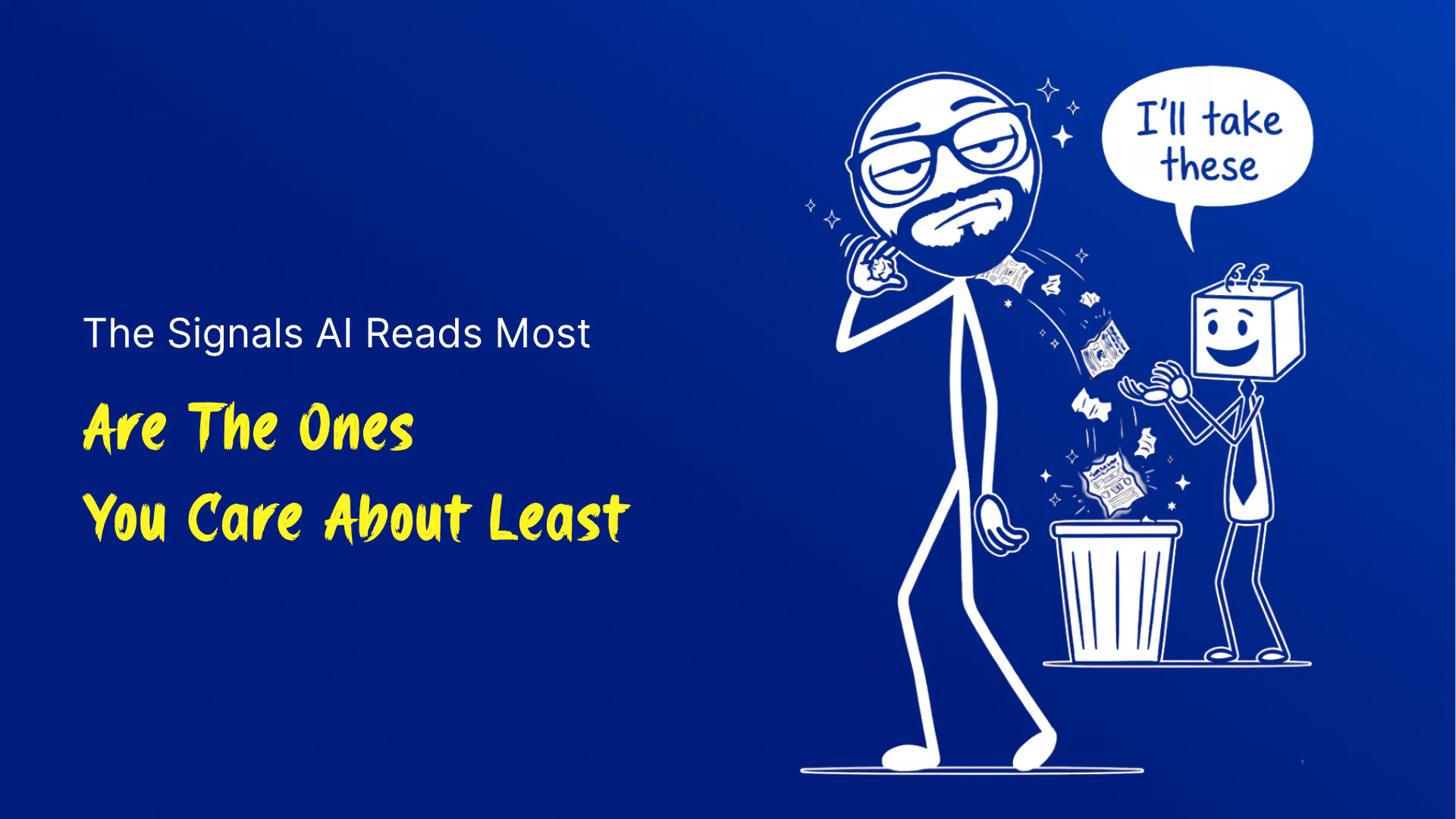
In my last two posts I wrote about narrative compression - how AI squashes everything it knows about your company into a handful of sentences - and the coherence gap that opens up when different AI tools tell different stories about you as an employer. If you haven't read those yet, start here and here. This one gets practical.
That coherence gap doesn't live in your EVP document or your brand campaign. It lives in the disconnect between what you say about yourself in the places you control and invest in, and what you say in the places you don't think anyone's paying attention to.
Your careers page says you're a people-first organisation. Your job ads say "must thrive in a fast-paced environment with high ambiguity, able to self-direct with minimal oversight." Your interview process spends 55 minutes asking what the candidate can do for you, then offers two minutes at the end for them to ask a question. Which version is real?
Candidates know. And increasingly, so does AI.
The hero piece vs. the high-frequency signal
Most employer brand investment goes into what I'd call the hero piece. The EVP launch. The careers page redesign. The brand film. The big LinkedIn moment. These are the surfaces the employer brand team owns, controls, and cares about. They're polished, on-message, and usually pretty good.
Then there's the high-frequency stuff. The signals that repeat at volume, day after day, across every channel a candidate or employee touches. Job adverts - hundreds of them, live right now, each one written by a different hiring manager with zero brand oversight. LinkedIn company page posts. How you respond to Glassdoor reviews. Recruiter outreach messages that get screenshotted and shared. Your Indeed profile that someone set up three years ago and nobody's updated since. Employee LinkedIn posts. Candidate FAQs. Interview confirmation emails.
These are the surfaces AI reads at volume. These are what narrative compression captures. And in most organisations, nobody is looking at the aggregate signal these surfaces are sending.
Enjoying this? I can pop the next one in your inbox if you'd like.
The job ad problem
Job adverts are the single biggest high-frequency signal most companies get wrong. And it's not because people aren't trying (well... Sometimes it most definitely is!) It's because the incentive structure is broken.
The hiring manager needs a role filled. They write a description of what they need - the skills, the experience, the qualifications, the behaviours. They're writing an internal requirements document that happens to get published externally.
Read ten of your own company's live job ads right now. Count how many sentences describe what the candidate gets versus what the company wants. The ratio is brutal. Paragraph after paragraph about what you need, what you expect, what the ideal candidate looks like. Maybe a line at the bottom about "competitive salary and benefits package." The candidate has disappeared from their own recruitment experience.
Your EVP says you value people. Your job ads say you value what people can do for you.
It doesn't stop at the job ad
The interview process is one of the first places where the real culture shows up. A candidate reads your careers page, sees a compelling story, clicks through a job ad that's mostly about the business but proceeds anyway. Then they sit down for an interview.
Forty-five minutes of competency questions. What experience do you have? How would you handle this situation? Tell me about a time you delivered under pressure. What would you bring to the team? Every question pointed in one direction - what can you do for us?
If you're lucky, you get five minutes at the end. More likely two. "Do you have any questions for us?" That's not a conversation. That's an afterthought. And the candidate walks out knowing exactly which version of the company was real - the careers page that talked about what they'd get, or the interview that only asked about what they'd give.
This isn't a high-frequency signal in the way job ads are - AI isn't sitting in your interviews. But candidates talk about it. On Glassdoor. On Reddit. On LinkedIn. The interview experience becomes a signal generator, and AI reads those signals at volume.
Specifics beat slogans
This connects directly back to how AI understands you. AI needs specifics. When every company says they're "innovative" and "collaborative" with a "great culture," AI has nothing to differentiate you with. You compress into the same generic mush as everyone else.
But specifics compress distinctively. Instead of saying you're innovative, write about how your R&D team ships a working prototype every two weeks and tests it with real customers before anything gets near a roadmap. Instead of saying you're collaborative, talk about how product squads form across engineering, design, marketing, and customer success to pull a product through end-to-end - not just build it, not just market and sell it, but train people how to use it too. Instead of saying you have a "supportive culture," describe what actually happens when someone has a bad quarter.
Those specifics give AI something to work with. They give candidates something to work with. And they give your employer brand a shape that's yours, not a template anyone could claim.
How do you get to the specifics?
You do an honest examination of your working realities. Hold up the mirror and look at the reflection, even if you don't like what's staring back at you.
What actually happens in your organisation every day? Not what you wish happened. Not what your values poster says should happen. How do decisions really get made? What does collaboration actually look like on a Tuesday afternoon? What happens when a project fails?
Frame what you find in a way that's genuinely real to your culture and work environment. Some people will gravitate towards it. Others won't. That's not a risk - that's the entire point.
An EVP that attracts everyone attracts no one with conviction. The specificity that makes some candidates think "that's exactly what I'm looking for" is the same specificity that makes others think "HELL NO! That's not for me." Both responses mean it's working.
Your high-frequency signals - job ads, LinkedIn content, review site responses - should all reflect those working realities. Not the polished version. The real one. Because that's what AI compresses. That's what candidates remember. And right now, for most organisations, the gap between the hero piece and the everyday signal is where your employer brand goes to die.
Like what you're reading?
If my content resonates with you, I can deliver it to your inbox whenever I publish something new. No fluff and definitely no spam.


