
Hiring headache or creaking culture? A fairer way to measure Quality of Hire

When a new hire doesn't work out, the finger usually points one way - at talent acquisition. They found the person, they ran the interviews, they convinced them about the job. So if it goes wrong, it must be a hiring balls-up, right? Not necessarily and I think too many TA teams set themselves up for an unnecessary kicking, when it comes to quality of hire (QoH).
Sometimes the fault for a low quality hire does lie at TA's door. But a lot of the time it's messier than that, and I've been doing my best to stop one of my client's TA teams carrying the can for broader, company cultural problems that aren't theirs.
Think about a football transfer. A club's scouts spend months watching a striker who's scoring for fun at their old club. They sign, and then barely find the net all season. Was that bad scouting? Maybe. Or maybe the manager played them out of position, the system didn't suit them, and nobody helped them settle. Plenty of players flop at one club and flourish at the next. (Unless they come to Spurs. Then, whether manager or player, they all seem to flop and/or get injured! 🤕 😭). Same player, different environment.
Hiring works the same way, and yet companies tend to judge it as if the scout is the only one who touched the ball.
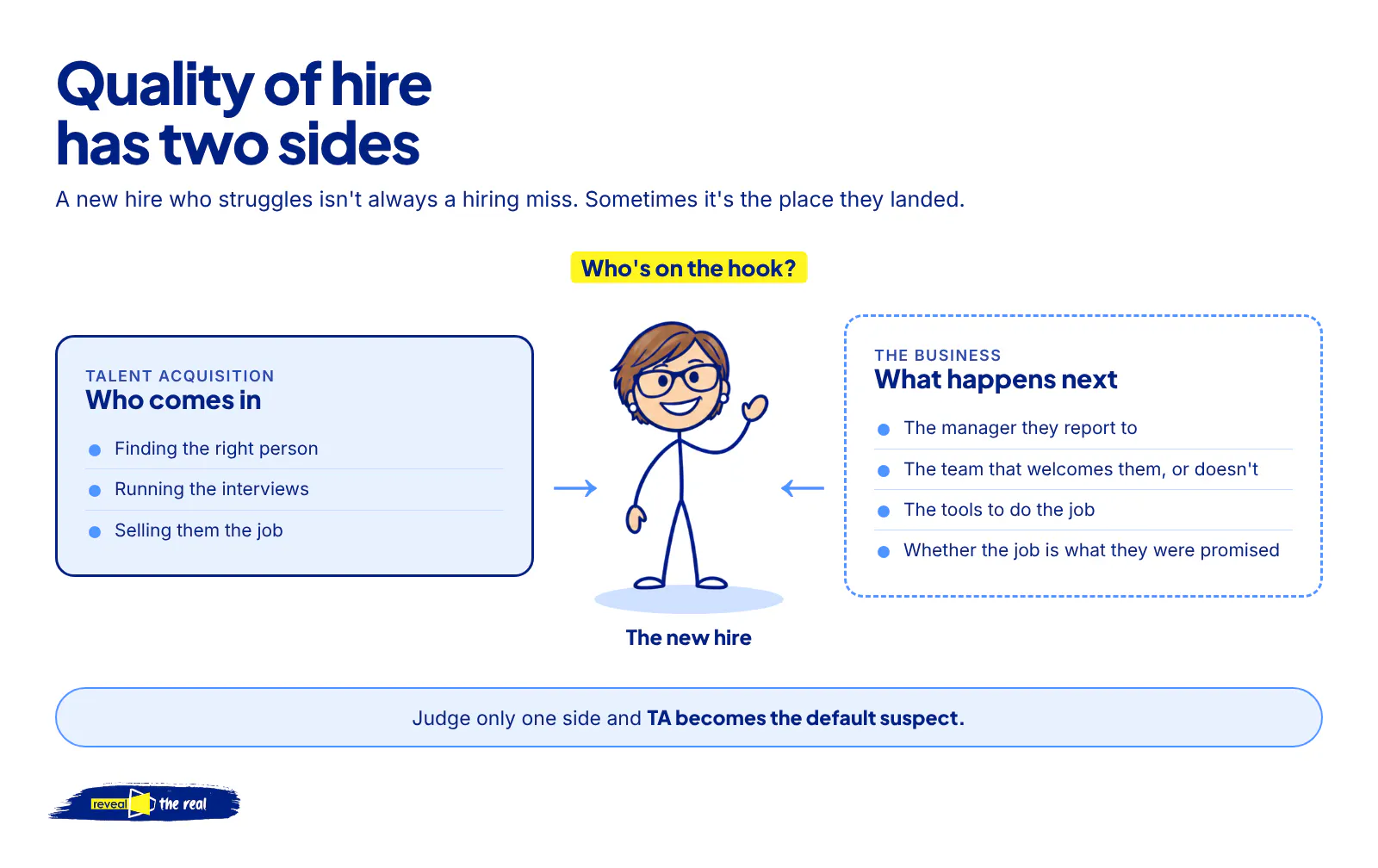
When does TA stop being on the hook?
Quality of hire has always been a tricky one to measure. The question that never quite gets answered is when responsibility passes from TA to the rest of the business. Is it 30 days? 60? 90? 6 months?
I'm still working that out with my client but what we've landed on is how to measure it fairly, whatever the cut-off ends up being.
Why asking only the manager is unfair
My client was heading down a fairly standard path - survey the hiring manager at set points in the new hire's first few months and ask them to rate the person. It sounds sensible but I challenged it because it's unfair, as it's only half the picture.
I've worked in and around L&D for a while, and this reminded me of the age-old debate about performance versus potential, and the 9-Box Matrix people have been arguing over for years. How can you possibly assess potential? And what actually goes into someone's performance?
Someone could join a business as a genuine high performer and still struggle, because they don't get on with their manager. If the work isn't what they were promised, or the environment is the opposite of what they were told it would be like, that's not necessarily a poor hire. That's a poor environment, and that's on the business not TA.
There's also a very human problem with asking only one side. This won't apply to every manager, and plenty are brilliantly self-aware. But most people default to self-preservation when something goes wrong. If a hire doesn't work out, it's rare for a manager to hold up the mirror and say it was down to them, their own ability or their own lack of support. So, guess who tends to get thrown under the bus when this happens. I'll give you a clue. It starts with "T" and ends in "A". 🤔 That's not a dig at managers. It's just how people are wired.
Enjoying this? I can pop the next one in your inbox if you'd like.
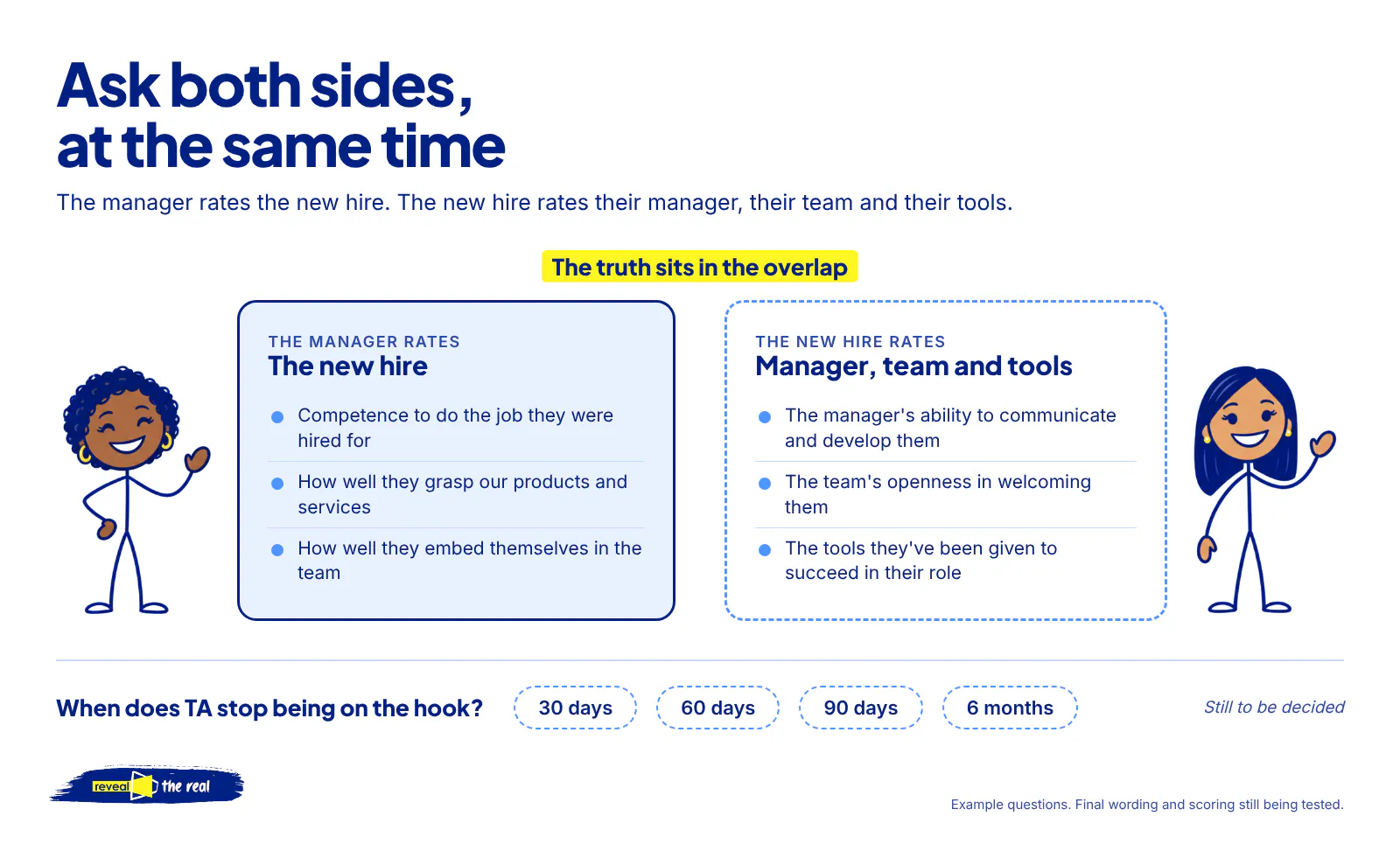
Asking both sides, at the same time
So instead of one survey, my client is looking to run a two-sided questionnaire. The hiring manager and the new hire get it at the same time, and the truth sits where their answers overlap.
The hiring manager is asked questions like:
- How would you rate the new hire's competence to do the job they were hired for?
- How would you rate their ability to grasp our products and services?
- How would you rate their ability to embed themselves in the team?
The new hire is asked questions like:
- How would you rate your manager's ability to communicate with / develop you?
- How would you rate your team's openness in welcoming you?
- How would you rate the tools you've been given to succeed in your role?
What the overlap tells you
We haven't settled exactly how it'll be scored yet, but we're looking at a simple quadrant:
- Both rate each other highly - a great hire, set up to thrive.
- Manager rates the hire low, new hire rates the manager high - the manager, team and tools look solid, so this is likely a hiring miss. Learn from it.
- Manager rates the hire highly, new hire rates the manager. team and tools lower - a great hire at risk. Fix the environment before they leave.
- Both rate each other poorly - something's definitely gone wrong, and the place to look first is in the mirror. Is it the hire or the manager, team and/or tools that are misfiring?
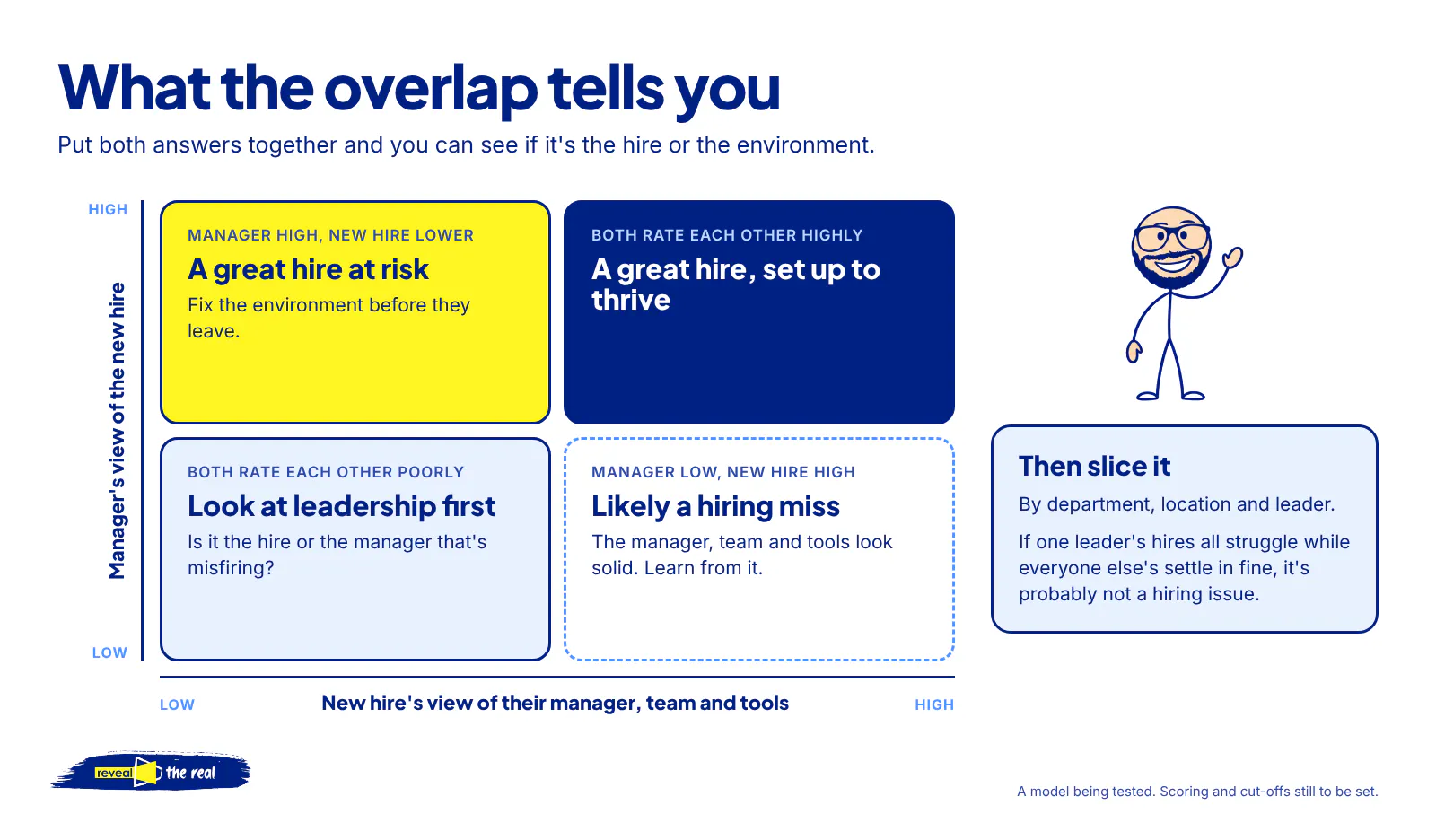
Then you can slice it by department, location and leader, which is where it starts to show patterns. If one leader's hires all struggle while everyone else's settle in fine, it's probably not a TA hiring issue. It's a leadership or culture one, and no amount of better interviewing will fix it.
Why this feels fairer
To be clear, we haven't got results yet. We're about to test it. But it's the most solid and fair way of looking at quality of hire that I've come across, because it does three things a manager-only survey can't:
- It takes some of the self-preservation bias out of the answer.
- It separates a hiring problem from an environment problem.
- It gives TA a fair hearing instead of making them the default suspect.
Over to you
I'd love to know how you measure quality of hire. Have you done anything better, or just different? Is there anything you'd add to the questions above, or a flaw you can already see?
If enough of us share what's working, maybe we can finally get to the bottom of quality of hire in a way that's robust, fair and as balanced as possible.
Like what you're reading?
If my content resonates with you, I can deliver it to your inbox whenever I publish something new. No fluff and definitely no spam.


