
The Definitive Guide to ROI in Employer Branding

We really need to get better at talking about ROI in employer branding and talent marketing. I've written and spoken about it quite a lot over the years (sorry), so this is me putting everything into one place.
It's meant to kick-start a more commercial conversation with the people who hold the budget in your organisation. Take it, swap in your own numbers and build a version that stands up in your company.
The wrong question
It usually starts with someone asking, "What's the ROI of employer branding?"
It's a fair thing to ask, but it's impossible to answer well. It tries to capture everything and, in doing so, achieves nothing. What, all of it? Every post, campaign, careers site visit and candidate email, across every hire, forever? Good luck working that out.
Part of the problem is distance. A salesperson makes a sale and you can see it on the P&L (profit and loss) pretty quickly. They're about 1 degree of separation from it. A talent marketer, on the other hand, works with or through a recruiter to share the culture that attracts the salesperson in the first place. The recruiter hires them, they start, and then they make the sale. That puts you somewhere in the region of 4-6 degrees of separation from the bottom line.
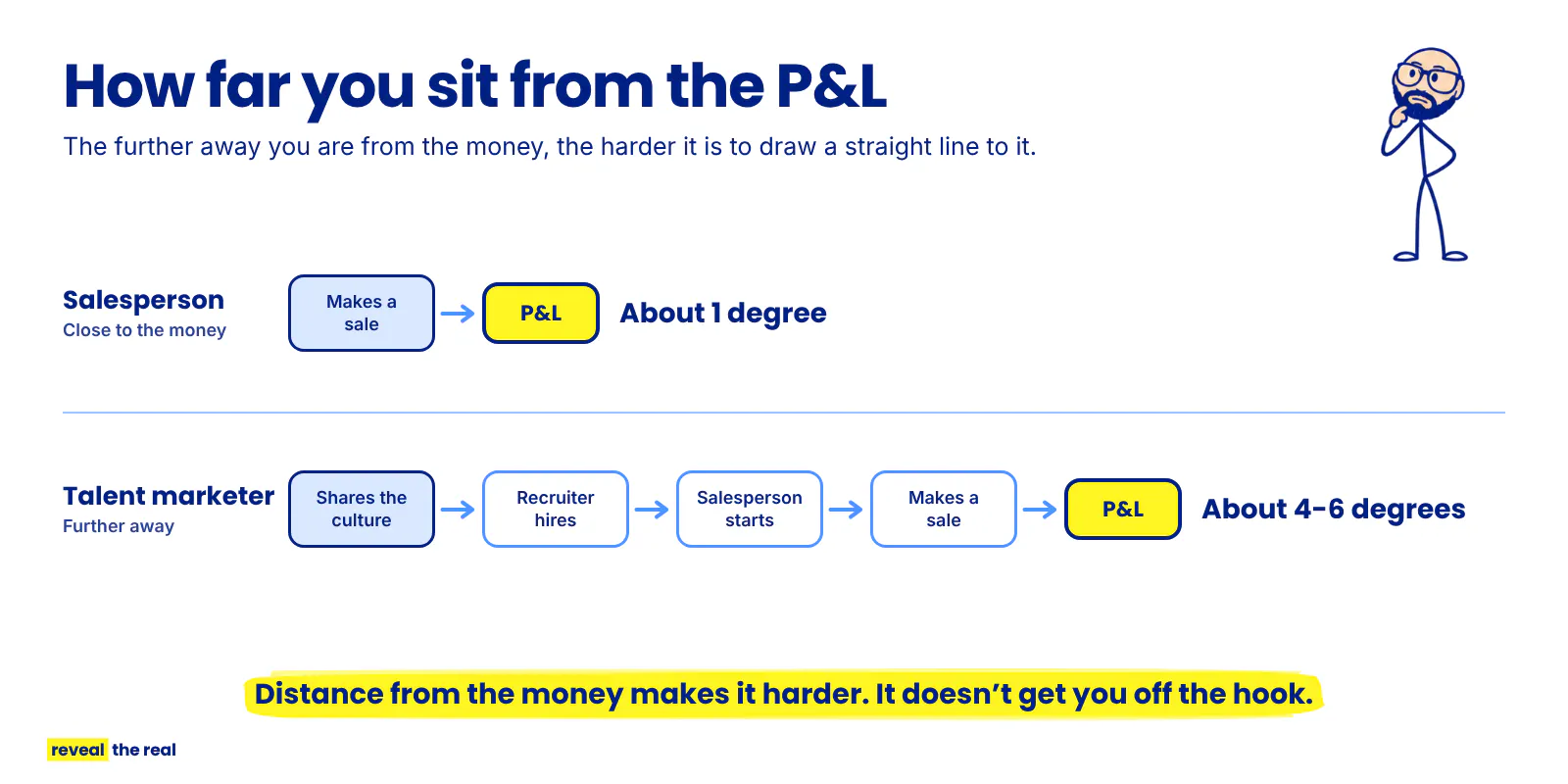
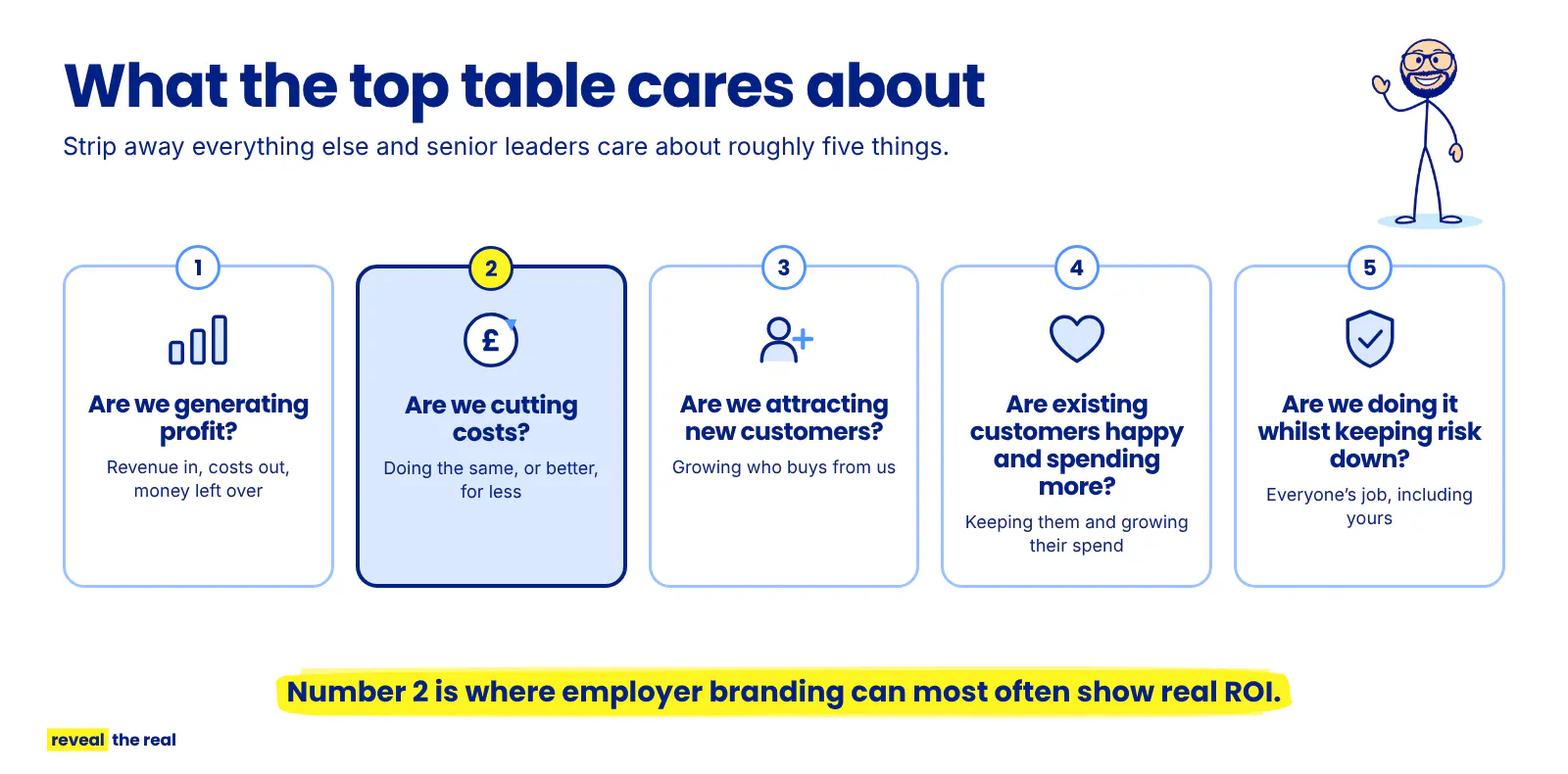
That distance makes it harder, but it doesn't get us off the hook. When you strip everything else away, business owners and the C-suite care about roughly five things:
- Are we generating revenue (top line)?
- Are we cutting costs? (to increase profit margin [bottom line])
- Are we attracting new customers?
- Are we keeping existing customers happy and getting them to spend more?
- Are we doing all of that whilst keeping risk down?
When budgets get tight, they don't give a crap about your clicks, visits and social media engagements. (To be fair, they don't care much about them when budgets are healthy either. 🤨) Of those five, the one employer branders and talent marketers can most often show a clear financial impact on is the second one - cutting costs.
Three things people mix up
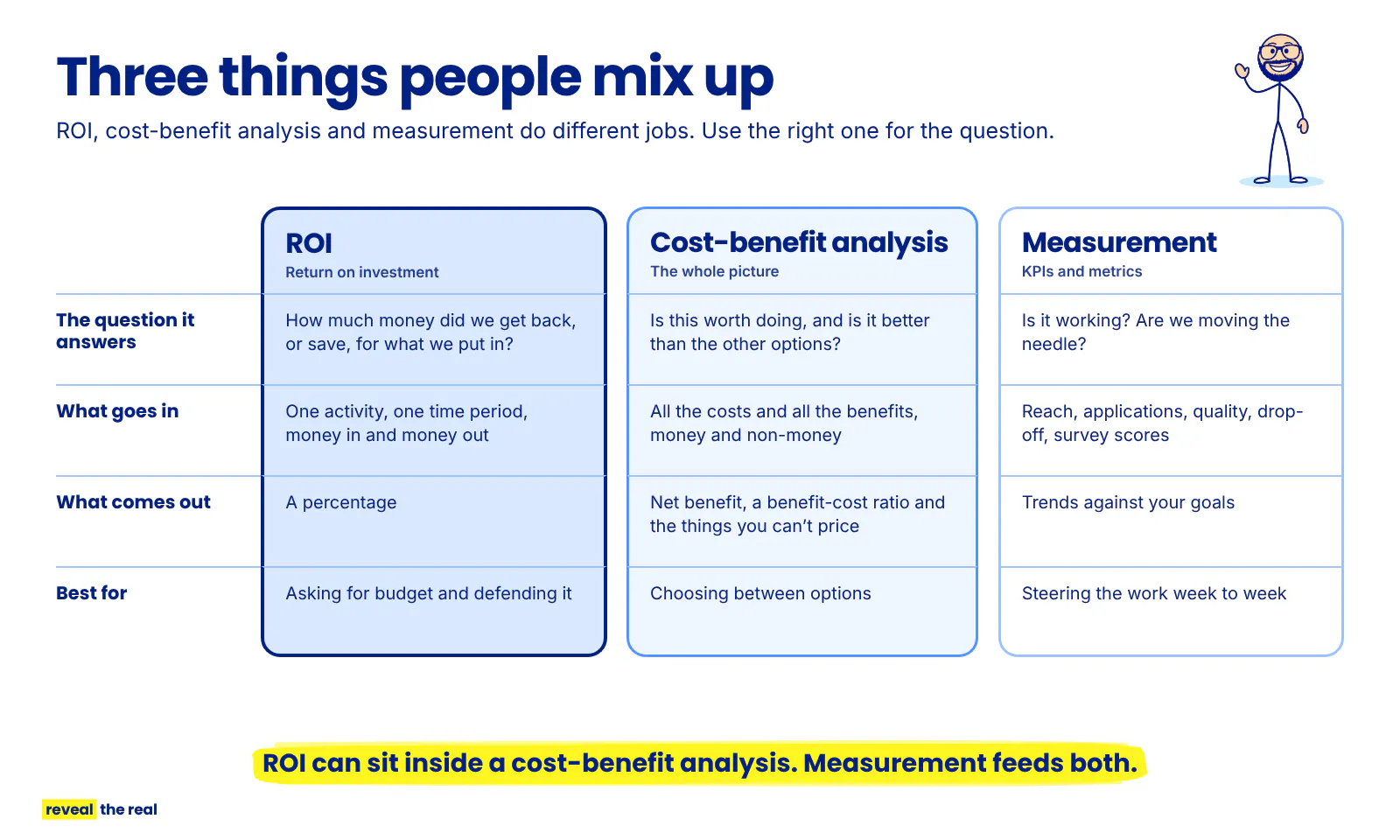
A lot of the confusion comes from using three different ideas as if they were the same thing.
ROI (return on investment) is a business metric, rather than a candidate, media, branding or content one. It's one financial number, for one activity, over a set period of time. It tells you how much money you got back, or saved, compared with what you put in.
Cost-benefit analysis is the bigger picture. It lists everything an option costs and everything it gives you back, money and non-money, so you can compare options and decide which one to back. ROI can sit inside it, but it's more than ROI.
Measurement is the KPIs and metrics that tell you whether you're moving the needle. Reach, applications, quality of applicants, drop-off rates, engagement survey scores and so on. It's vital, it just isn't ROI.
So if someone asks you for the ROI of something you're doing or planning, they want to see something financial - either gains or cost savings. Give them more than that and you're probably explaining the cost-benefit. That's incredibly important too, but it's a different conversation.
How to work out ROI
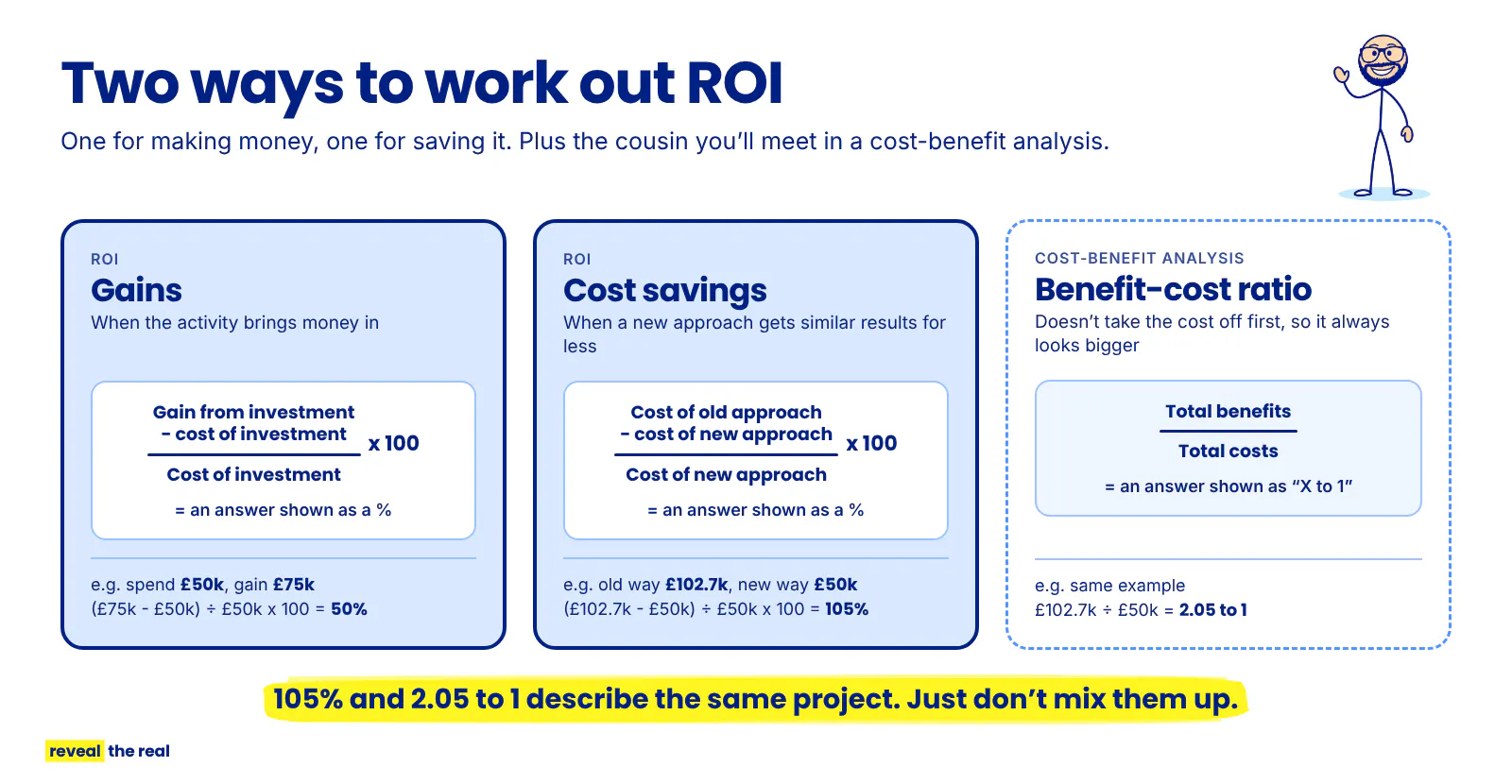
ROI comes in two flavours, depending on whether you're making money or saving it.
ROI on gains, when an activity brings money in:
(gain from investment - cost of investment) ÷ cost of investment x 100
ROI on cost savings, when a new approach gets you similar results for less than the old one:
(cost of old approach - cost of new approach) ÷ cost of new approach x 100
Both give you an answer as a percentage. Anything above 0% means you got back more than you put in.
There's also a cousin you'll meet in cost-benefit analysis, called the benefit-cost ratio. It's the total benefit divided by the total cost, and it's usually shown as "X to 1". Because it doesn't take the cost off first, it always looks bigger than the ROI for the same project. Both numbers are useful. Just don't mix them up in front of your finance director, because they'll probably spot it.
Every ROI needs three things
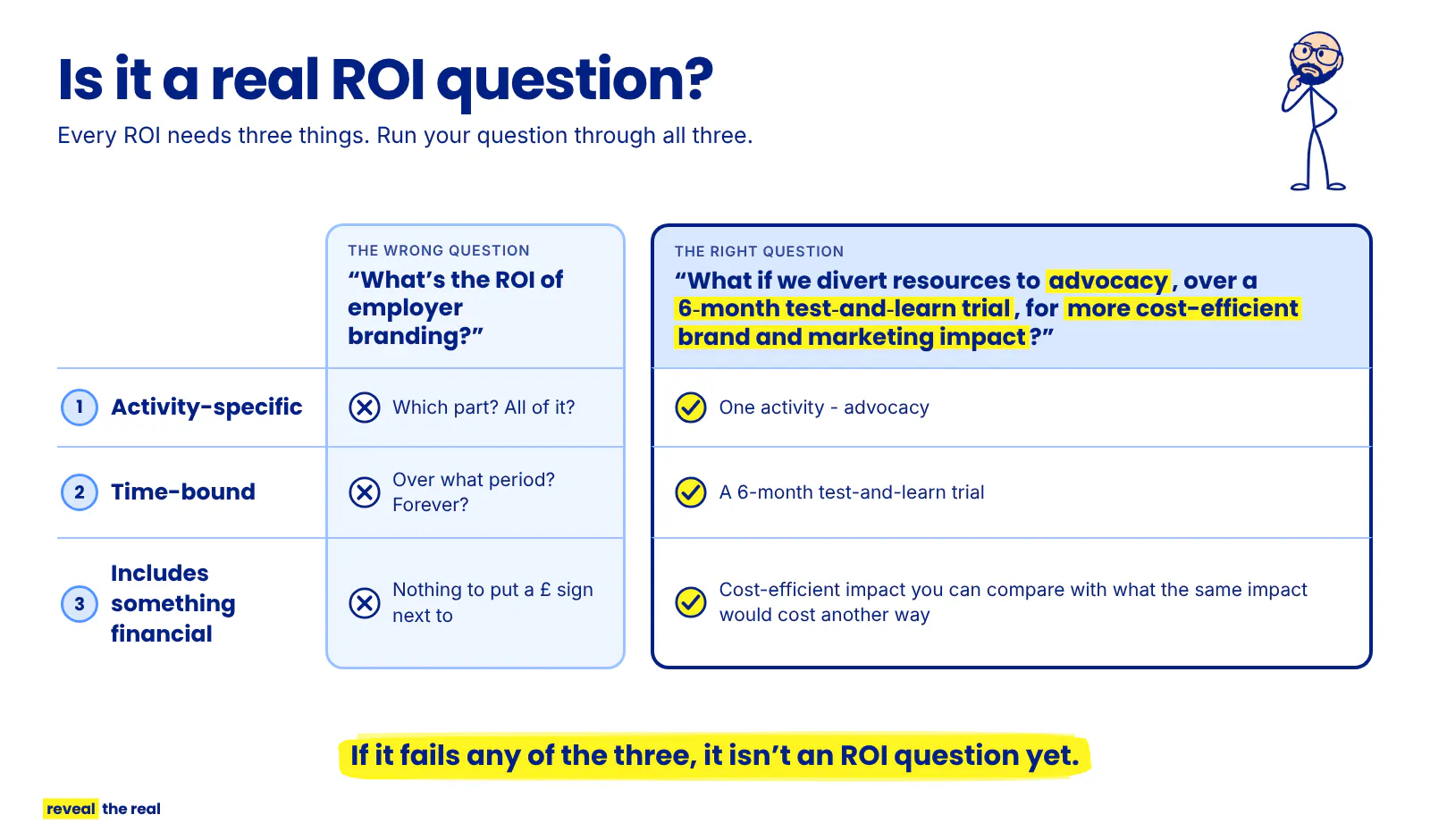
To calculate ROI you need three things. It has to be:
- Activity-specific - one thing you're doing, rather than "employer branding".
- Time-bound - over a set period, so everyone knows when you'll measure it.
- Include something financial - a gain or a saving you can put a £ sign next to.
Put "What's the ROI of employer branding?" through that test and it fails all three. It isn't about one activity, it has no time frame, and there's nothing financial attached to it.
Compare it with this one:
"What if we divert resources to advocacy, over a 6-month test-and-learn trial, for more cost-efficient brand and marketing impact?"
Advocacy is the activity. The 6-month trial is the time frame. Cost-efficient brand and marketing impact is the financial part, because you can compare what the trial costs with what the same impact would cost you some other way.
Enjoying this? I can pop the next one in your inbox if you'd like.
Where ROI lives (and where it doesn't)
In 2010, I came across a presentation by Olivier Blanchard on the basics of social media ROI. To this day, it's still one of my favourite ways to explain this subject, and my version of it looks like this:
- You make an investment - money, time, tech and people.
- Stuff happens - posts go out, campaigns run, advocates share content.
- People react to the stuff - your engagement rates and click-through rates.
- That adds up to non-financial impact - impressions, engagements, clicks, applications, better quality candidates.
- Some of it turns into financial returns or savings.
ROI only lives at the two ends - what you put in, and the money you made or saved. Everything in the middle is important stuff. It's how you know the activity is working, and it's often how you'll explain why the money moved. But ROI doesn't live there.
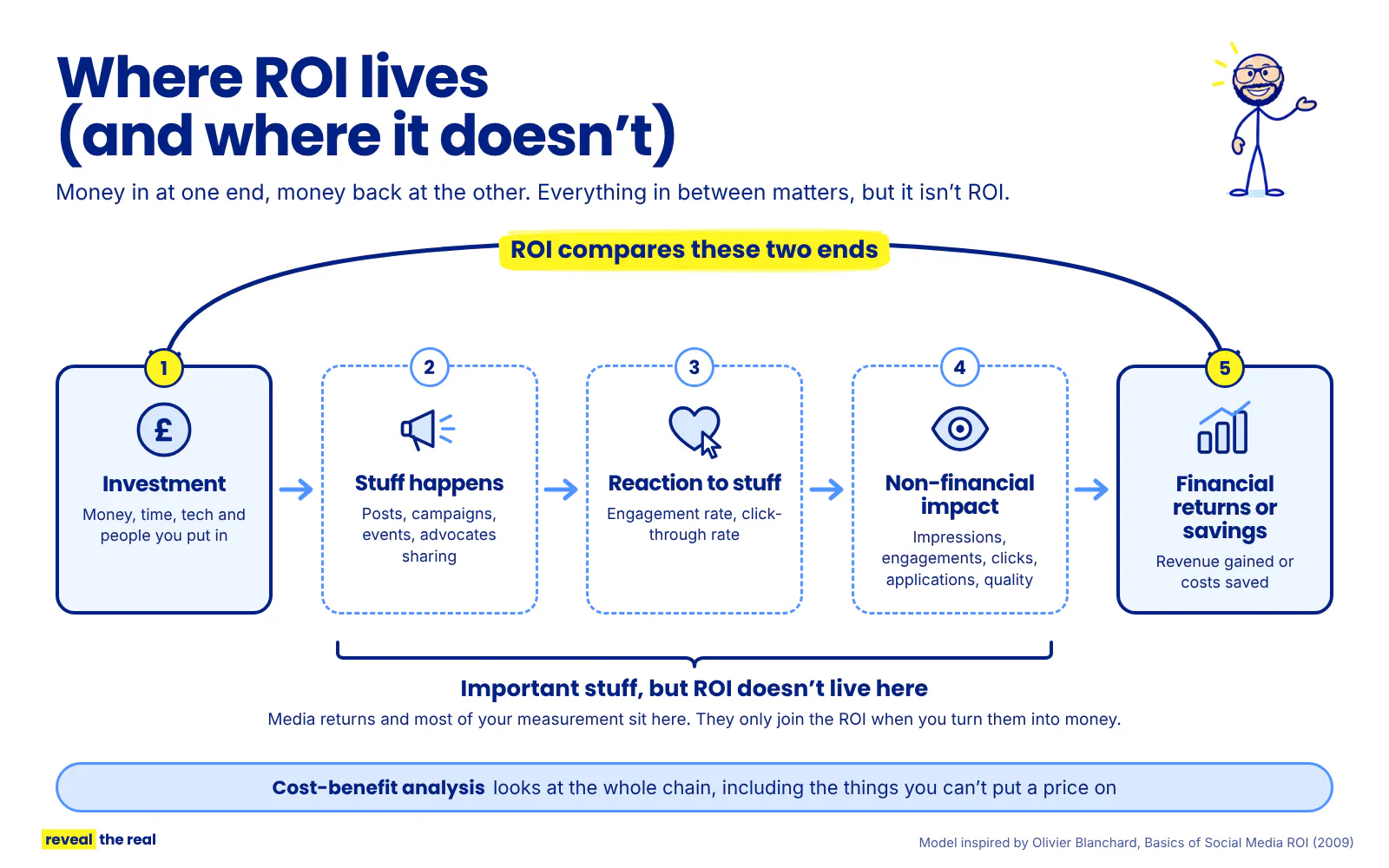
Media returns are a good example of this. Reach, impressions and engagement matter, and you should report them. On their own though, they aren't ROI. They only become part of an ROI when you turn them into money, for example by working out what the same reach would have cost you in paid media.
This is also where the three ideas from earlier sit. ROI compares the two ends. Measurement tracks the middle. Cost-benefit analysis looks at the whole chain, including the things you can't easily put a price on.
Where employer branding can show real ROI
Showing a direct line from employer branding to top-line revenue is really hard, for all the degrees-of-separation reasons above. The place you can most often hang your hat is reducing costs and getting more efficient - doing the same thing, or better, for less.
There are already ways to say this in the language business leaders want to hear:
- "We used to spend £1,000,000 on job boards, but since we switched to approach ABC, we're saving the business 50% of that budget whilst still achieving the same (or even better) results and quality."
- "We've reduced agency spending from £X to £Y, and we're now saving the business £Z."
- "Our advertising media spend was £A with a return of £B. We've made changes, and now we're seeing a £££ improvement in cost per application and/or hire, with improved quality, which in turn is saving the business..."
Cost savings aren't the be-all and end-all. I think being obsessed with them to keep the black-and-white finance minds in the room happy can sometimes kill creativity. But if you need to show business impact, it's something you can hang your hat on.
The revenue side is harder, but it isn't impossible. If the people you hire apply faster and are more compatible with your culture, they can start sooner, contribute to your revenue earlier and stay longer. That's the thinking behind Reveal Your Revenue Impact, which helps you model what that could be worth. The Time to Hire calculator does a similar job for TA business cases. It shows the financial impact of reducing time to hire, and the rising daily cost of roles sitting empty.
One caveat with both. As I've said before, branders should absolutely be on the hook for time to apply and quality of application. Time to hire is a different matter. Once a great candidate is in your ATS, a CV sitting on someone's desk isn't something your brand work can fix. So if you use revenue models like these, be clear about which part of the journey you're claiming, and build the case with your TA partners rather than around them.
A worked example - an advocacy pilot
This example is based on something I was putting together in a previous role. To keep the maths simple, it runs over 12 months.
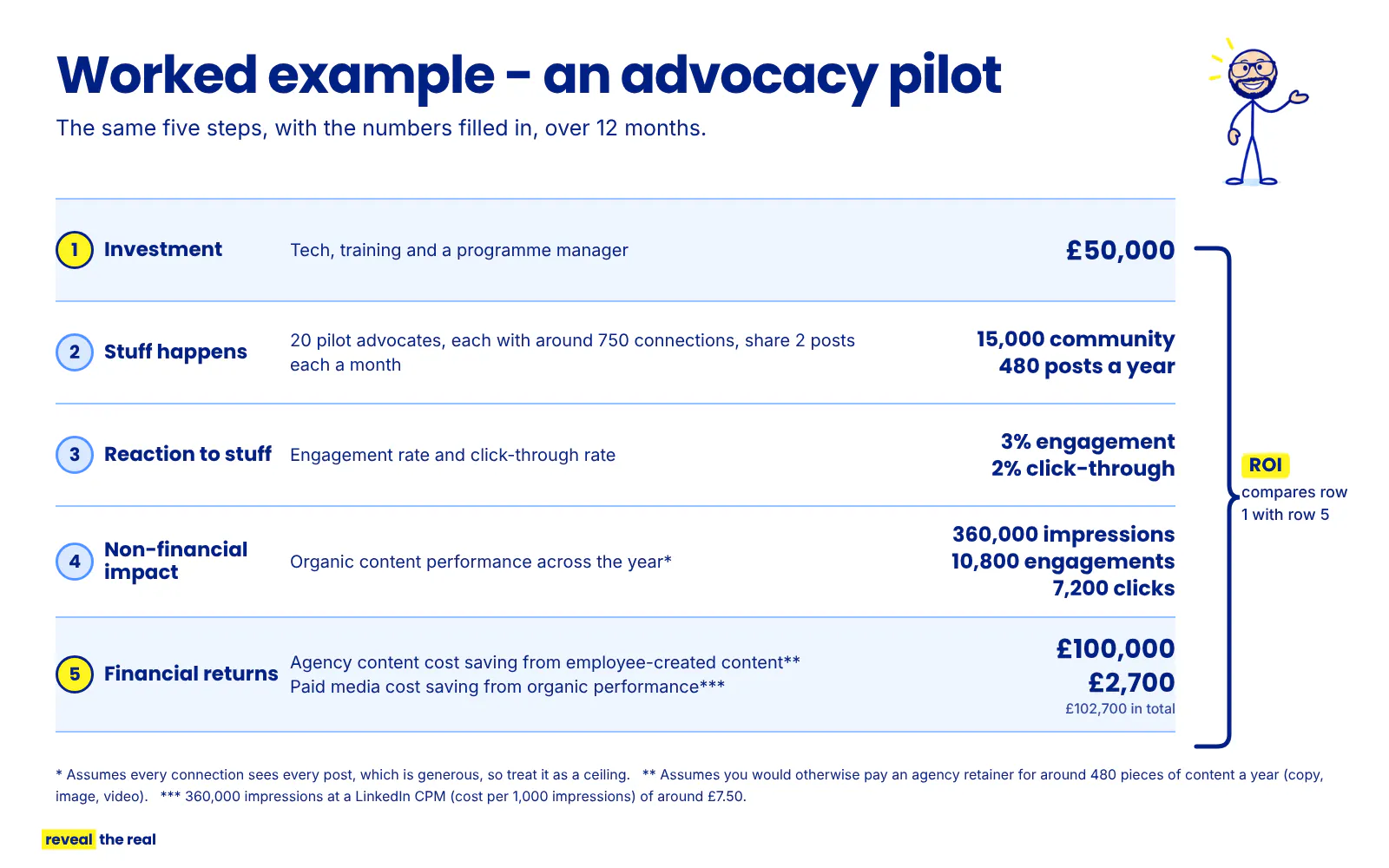
1. Investment. Tech, training and a programme manager cost £50,000.
2. Stuff happens. 20 pilot advocates, each with around 750 connections, share 2 posts each a month. That's a community of 15,000 and 480 posts a year.
3. Reaction to stuff. A 3% engagement rate and a 2% click-through rate.
4. Non-financial impact. If every connection sees every post, that's 360,000 impressions, 10,800 engagements and 7,200 clicks a year. Every connection seeing every post is generous, so treat it as a ceiling.
5. Financial returns.
- Agency content saving of £100,000 a year, assuming you'd otherwise pay an agency retainer for around 480 pieces of content (copy, image and video).
- Media saving of £2,700 a year, which is what 360,000 impressions would cost at a LinkedIn CPM (cost per 1,000 impressions) of around £7.50.
So you're investing £50,000 to get a similar brand and marketing impact to spending around £102,700 on an agency and paid media. Three numbers come out of that:
- ROI - (£102,700 - £50,000) ÷ £50,000 x 100 = 105%
- Benefit-cost ratio - £102,700 ÷ £50,000 = about 2 to 1 (2.05)
- Net saving - £102,700 - £50,000 = £52,700
If the savings arrive evenly through the year, the programme pays for itself in just under 6 months.
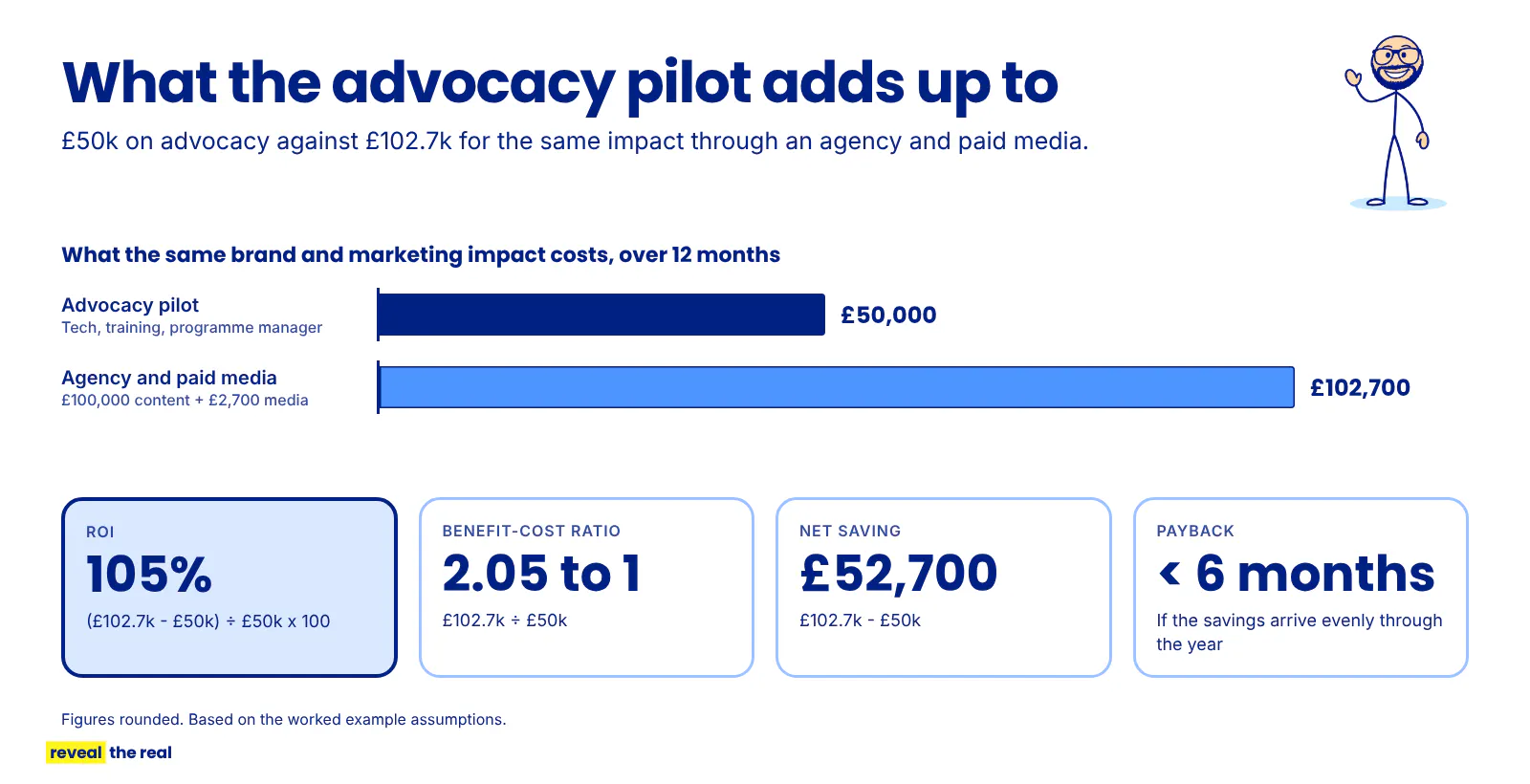
The agency content saving does almost all of the heavy lifting here. The media saving is small, because buying impressions at that CPM is relatively cheap. That's useful to know before you walk into the room.
And the conversation with your boss sounds something like this: "Our advocacy pilot is wicked-good, Chief. We predict that if we invest £50k, we can get a similar brand and marketing impact to spending around £102.7k on a creative agency and media. That's a 105% return, or a £52.7k saving in the first year." (YEAH, BABY!)
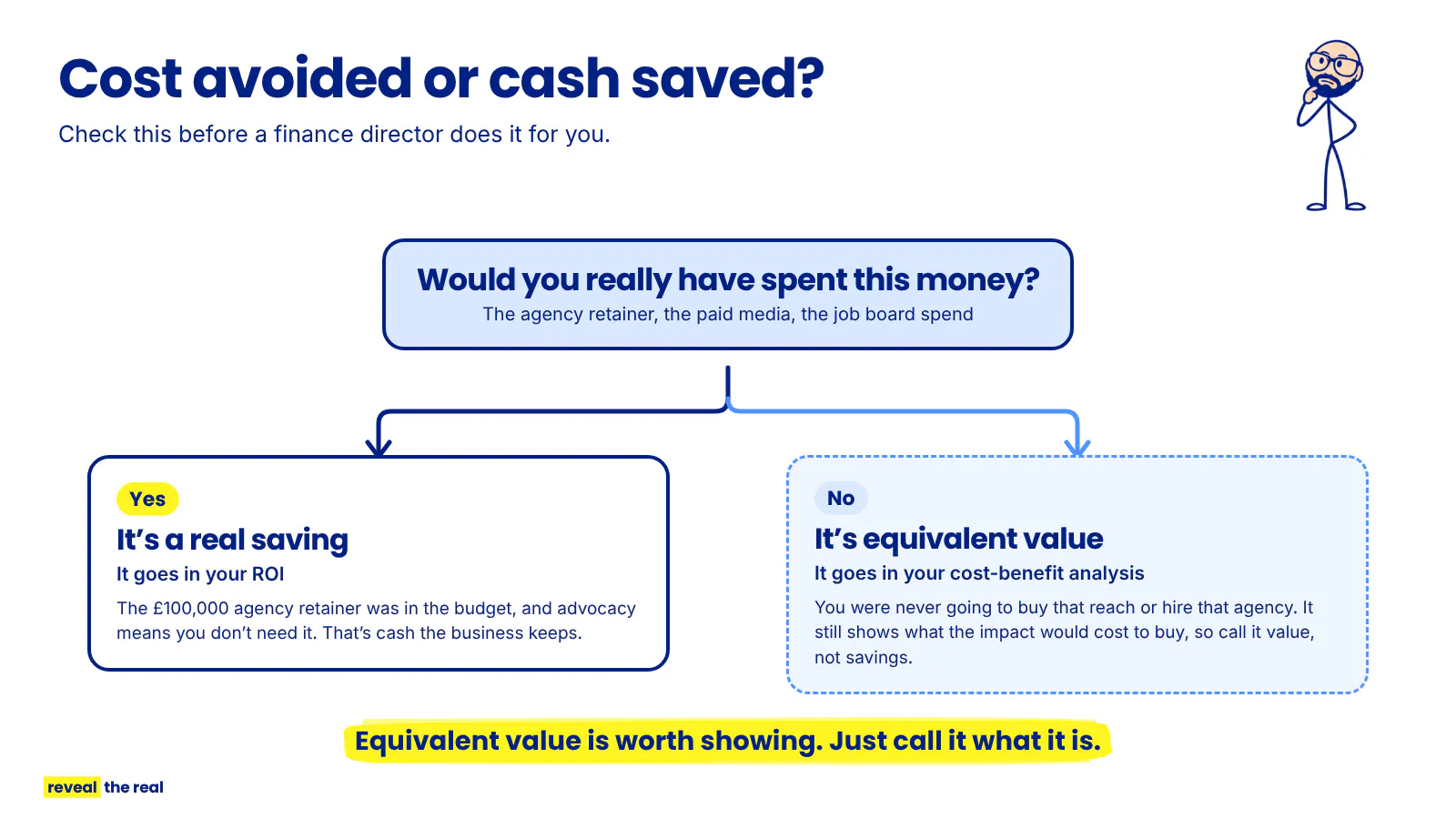
Cost avoided or cash saved?
A good finance director will probably ask this early on, so get there before they do.
A cost saving only counts in your ROI if you would really have spent that money. If the £100,000 agency retainer was in the budget, or was going to be, switching to advocacy saves real cash and it belongs in the ROI. If you were never going to hire that agency, the £100,000 is equivalent value. It's still worth showing, because it tells people what the impact would cost to buy. It just belongs in your cost-benefit analysis rather than your ROI.
The same goes for media. Equivalent media value is a useful way to put a price on reach, and it only becomes a saving if you would otherwise have bought that reach.
If you want to build this for your own advocacy programme, Reveal Your Advocacy ROI does the maths for you. It sets what your programme costs against what the same reach and content would cost through agencies and paid media, with every assumption on show so you can defend each number in the room. It's also upfront that it's a marketing impact ROI rather than an accounting one, so use the check above to decide which parts are real savings and which are value. If you'd like to see me walk through the thinking, this video on calculating the ROI of employee advocacy covers it.
What doesn't belong in ROI (but still matters)
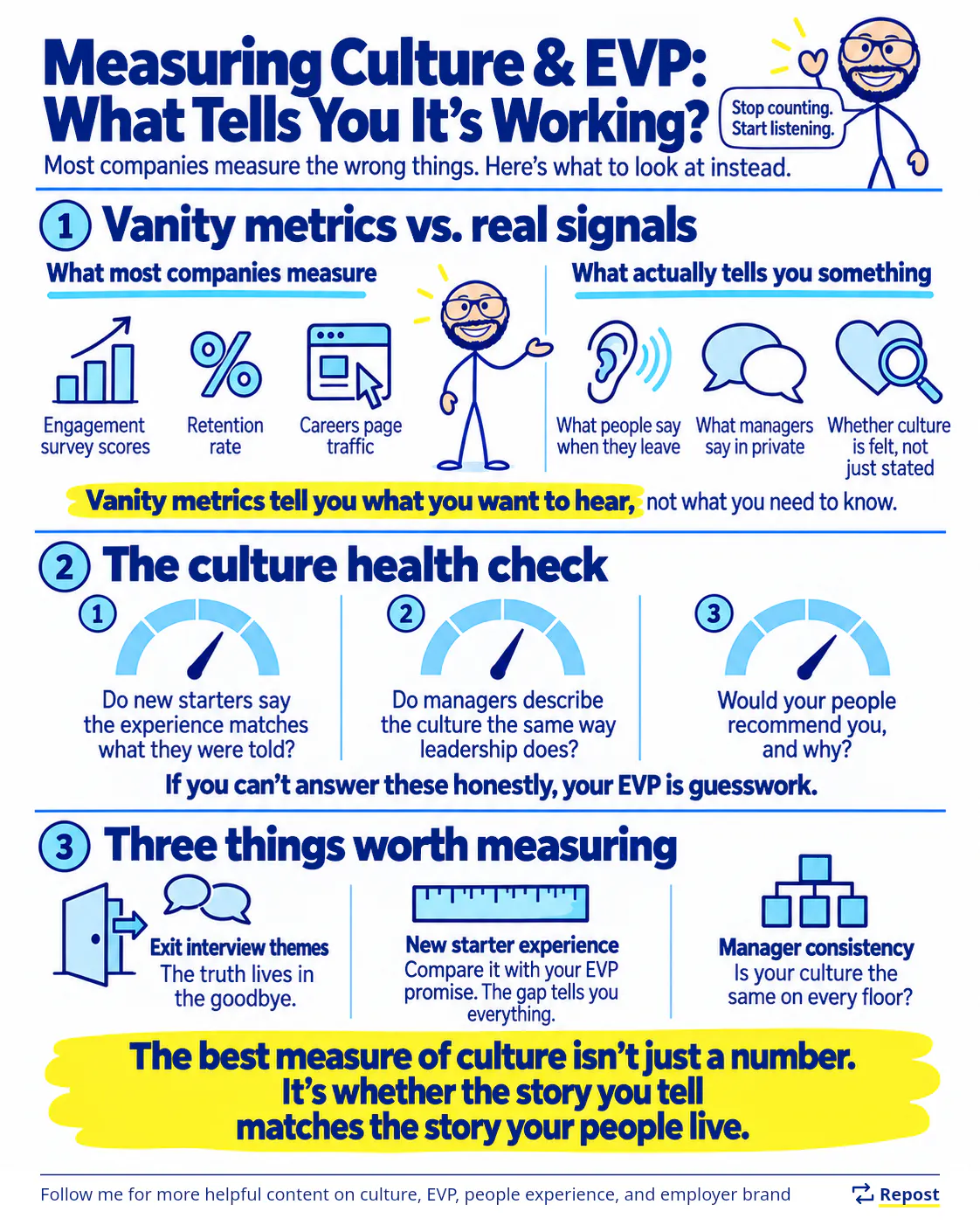
These are all worth measuring. They're measurement rather than ROI:
- Reach and impressions. Quick reminder of the difference - reach is getting in front of one person, impressions is getting onto a screen. If one piece of content hits my phone, tablet and laptop, that's a reach of 1 and 3 impressions.
- Engagement. Loads of people engaging with your content is great, unless it's all negative. You can't talk about engagement without talking about sentiment.
- Community growth. When I was at Tesco, my boss asked how quickly I could get him 5,000 Twitter followers. I said if he gave me a budget, probably a week or two, but would he rather have 5,000 random followers or 500 relevant people who could be candidates in the future? He thought for a second and, obviously not understanding what was more important said, "I'll have the 5,000 followers please." (Cue the personal sense of 'FML! 🤦🏼). Quality over quantity, every time.
- Glassdoor ratings. It's easy to cook those books, so be careful treating them as a measure of brand sentiment.
- Employee NPS. It's not the same as customer NPS, and it isn't always a sign of engagement.
- Time to hire, as a brand KPI. Own time to apply and quality of application instead, as long as you wrap them in any caveats necessary for your situation. For example does the gun fire for 'time to apply' as soon as a req is live in your ATS or live on your site? Sometimes they're not the same. Do you want to measure 'time to apply' or can you make it more robust and measure 'time to apply... For those people we successfully hire'? The premise being that you want to know how long it takes for the people you hire to apply, so you can focus on engaging the right talent faster - not just any Tom, Dick, or Harry.
None of this is ROI, and that's fine, as long as nobody presents it as ROI.
Building the case without getting burned
- Start with the goal. Strategy 101 - purpose, then goals, then the right KPIs for those goals, then the metrics underneath the KPIs. Branding is a long-term play. If someone asks for some branding and, in the next breath, wants 50 salespeople yesterday, what they need is a direct response campaign, and you measure that very differently.
- Agree what the words mean. Branding, direct response, upper funnel, quality of application. If everyone has their own definition, you end up agreeing things at cross-purposes and measuring them in ways nobody expected.
- Pick one activity and run it through the three rules. Activity-specific, time-bound, includes something financial.
- Use numbers your stakeholders trust. Draft it with your own parameters, socialise it internally, then firm it up together with data your stakeholders are comfortable with.
- Start small. Begin with a minimum viable version, standardise once you've tested, learned and set your own benchmarks, then optimise. The pain comes when you promise the optimised version from a standing start and end up going back to stakeholders cap in hand, saying "I'm very sorry, we can't measure that."
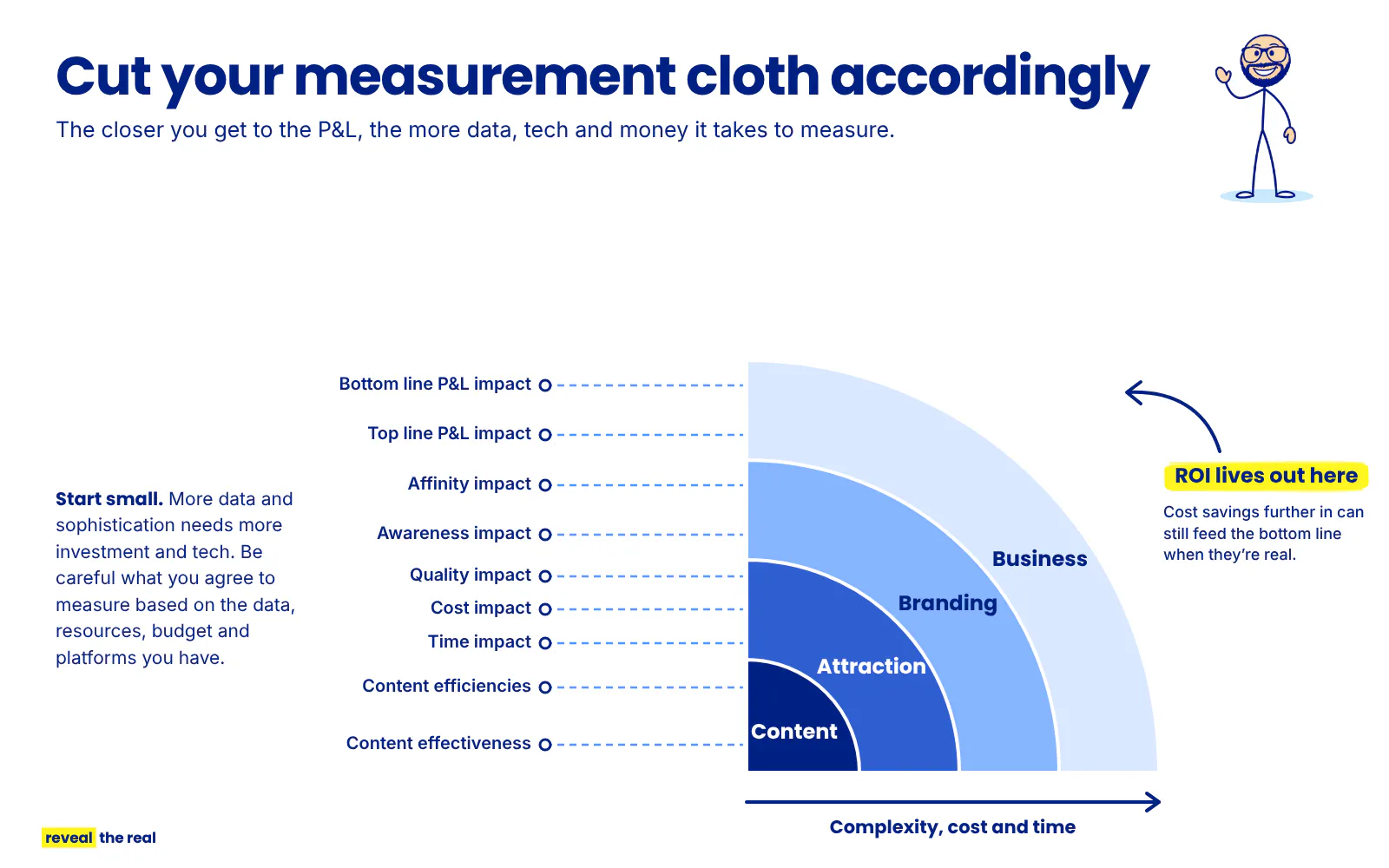
More data and sophistication needs more investment and tech, and data ain't cheap. Be careful what you agree to measure based on the data, resources, budget and platforms you actually have.
Reporting it so people care
Numbers don't do much if nobody understands them. Know who's reading each report, how senior they are and what they care about, then serve them the layer they want most, in language they can easily digest. I wrote more about this in measuring talent marketing impact and audience-tailored reporting.
Non-marketers don't understand marketing jargon and acronyms. If your report has them in it, take them out. They're too busy to decipher marketing code.
And give efficiency the same airtime as effectiveness. "You got 1,000,000 impressions. HOORAH!" is fine, until your CFO learns your CPM was £5 when the average for similar engagement is £0.90. Their eyebrow will be raised, and not in a good way.
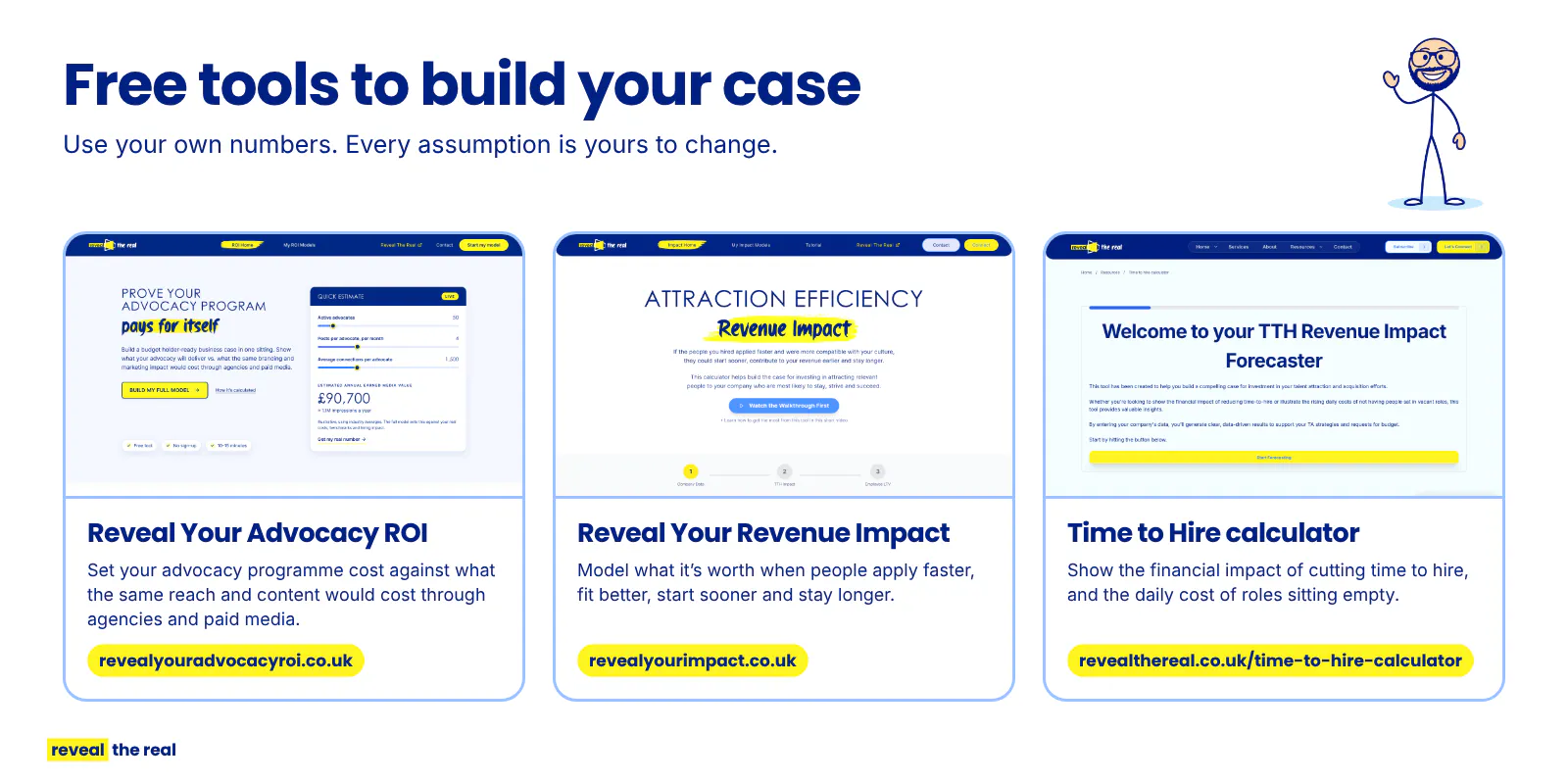
Free tools to help you build your case
- Reveal Your Advocacy ROI - build a budget holder-ready business case for an advocacy programme. Free, no sign-up, about 10-15 minutes.
- Reveal Your Revenue Impact - model what faster, better-matched hiring could be worth to your revenue.
- Time to Hire calculator - show the financial impact of reducing time to hire, and the daily cost of empty roles.
The one-page version
If you want something to share with your team or pin above your desk, this is the whole guide on one page.
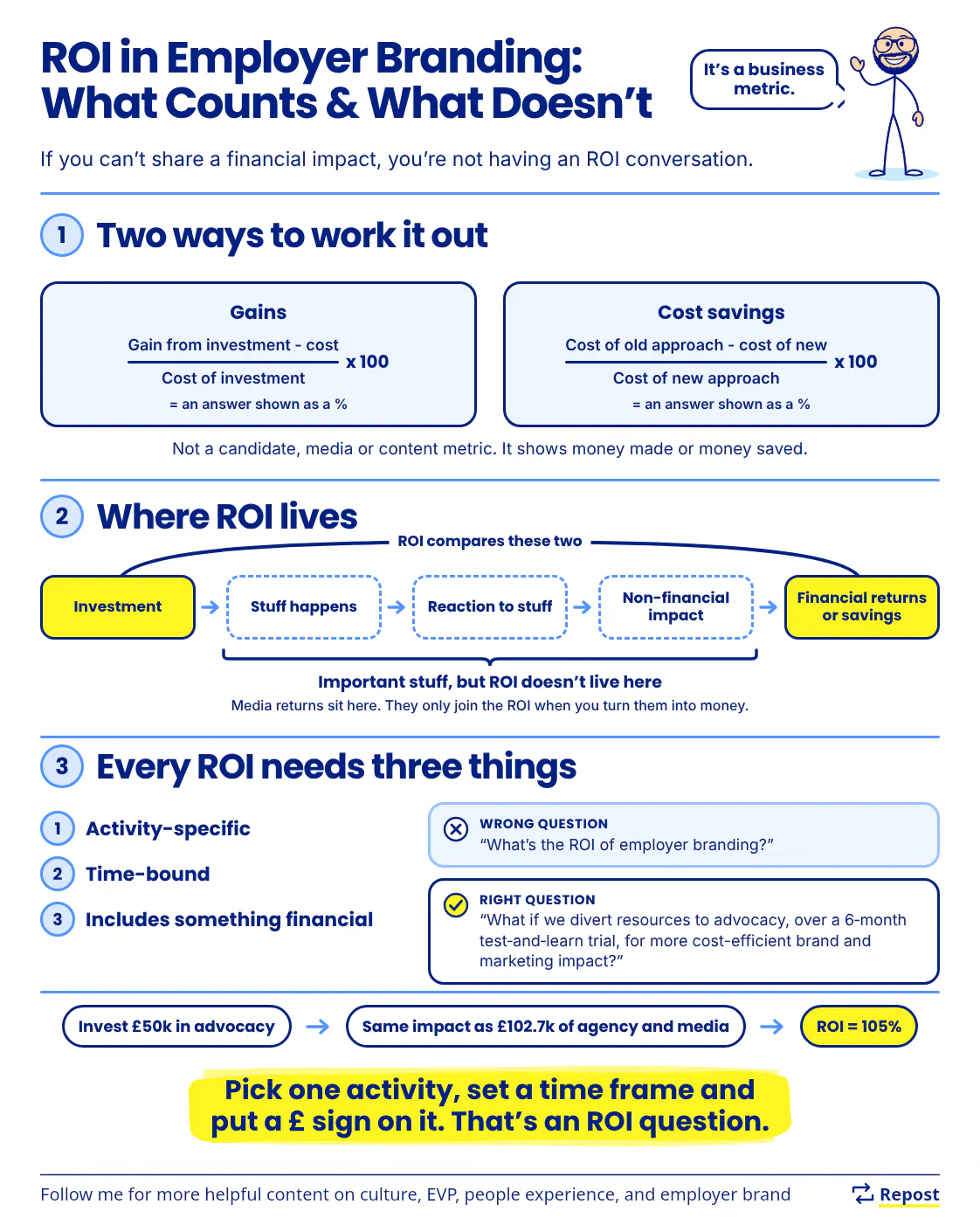
Where to start
Pick one thing you're already doing, or want to do. Run it through the three rules. Work out what it costs, what it saves or earns, and over what period. Then decide which bits are ROI and which bits belong in the wider cost-benefit story.
Check out the Little Lightbulb animation to help bring the learning to life.
I hope this helps you have the commercial conversations being asked of you, and if you'd like a hand building yours, get in touch.
Credit: some of my imagery has been inspired by (stolen with pride), and altered from, Olivier Blanchard's Social Fresh Conference 2009 presentation.
Like what you're reading?
If my content resonates with you, I can deliver it to your inbox whenever I publish something new. No fluff and definitely no spam.


