
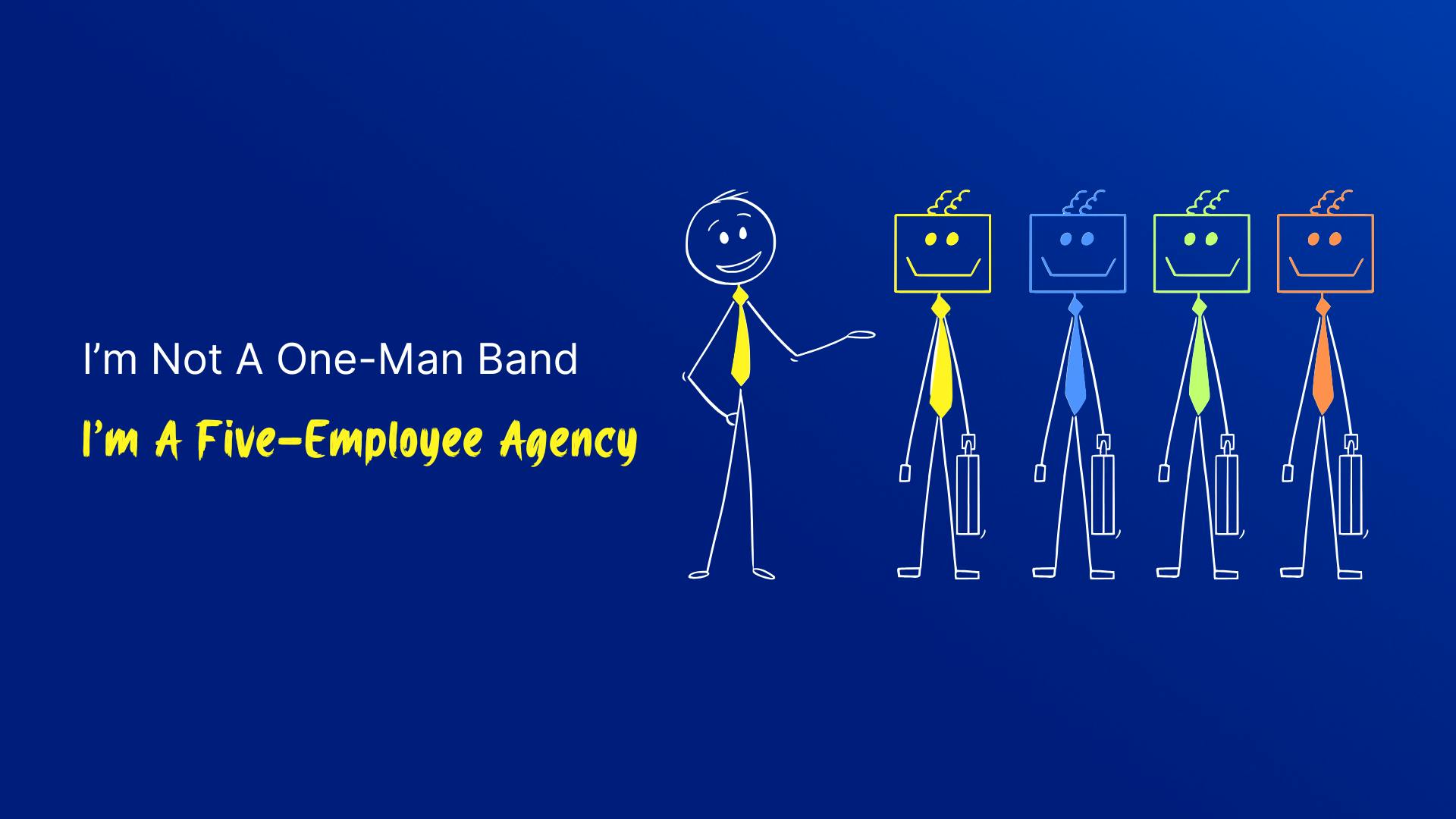
I'm Not a One-Man Band. I'm a Five-Employee Agency.
The solo consultant myth
There's a persistent assumption in consulting that if you work alone, you are alone. One person means one person's output. One brain, one pair of hands, one calendar. Your ceiling is your capacity, and your capacity is you.
That assumption is now completely, demonstrably wrong.
I run Reveal The Real - a company culture and talent engagement consultancy. From the outside, it probably looks like a one-man operation. And technically, on the payroll, it is. But in practice? I'm running a five-employee agency. The difference is that four of those employees happen to be agentic AI. They don't take lunch breaks. They don't call in sick. And they're producing work that would have taken a team of three or four humans days to complete - in hours. Not to mention, I'm connected to some of the best and brightest specialists in the industry - an interconnected network of professionals I trust and partner with when a project needs expertise beyond my own. So the 'one-man band' label has never been further from the truth.
This isn't a thought piece about the future of AI. This is what I'm actually doing right now, today, in my business. And if you're still treating AI as a novelty or a nice-to-have, you're already behind.
Why most people are still using AI like a fancy search engine
A day doesn't go past where I scroll through LinkedIn and see people still poo-pooing the quality of AI outputs. They've asked ChatGPT to draft an email or summarise a document. They've played with image generators. They've maybe used Copilot to tidy up a spreadsheet.
And then they've gone back to doing everything the way they always did. Because what they experienced felt like a slightly smarter Google - useful, but not transformative. So they wrote it off.
The problem isn't the technology. It's the approach. I refer to this as P.I.C.N.I.C - problem in chair, not in computer. Using AI to answer a question is like hiring a brilliant consultant and only asking them to make tea. You're dramatically underestimating what's possible.
What's changed - and changed fast - is the emergence of agentic AI. Tools that don't just respond to prompts but actively do work. They research, draft, build, test, iterate, and deliver. They operate with context, memory, and judgement. They're not autocomplete on steroids. They're genuine collaborators.
The gap between 'I use AI' and 'AI is part of my team' is enormous. Most people are stuck on the wrong side of it.
What my five-employee AI agency actually looks like
Let me be specific about what this means in practice, because vague claims about AI productivity are exactly the kind of shite I spend my life wading through on my socials.
Custom marketing plugin - built in a one hour session. I needed a marketing system tailored to my brand voice, my competitors, my content workflow, and my audience. Not a generic template - something that knows Reveal The Real's tone of voice, understands the difference between my consulting brand and The Talent Palette, and has my competitor landscape pre-loaded. Using Claude Cowork in my desktop app, I built a fully customised marketing plugin - seven commands, five skill sets, all baked with my brand guidelines - in a single working session. That's work that would typically involve a marketing strategist, a brand consultant, and a developer. Three people, probably two weeks. I did it this very Sunday morning before I had time to finish my first coffee of the day.
Branded documents, proposals, NDAs, SOWs and presentations - produced to spec. Every document I produce follows specific brand guidelines: Century Gothic headings, Inter body text, a four-colour palette, precise spacing rules, and a tone of voice that's conversational but authoritative. My AI agents know all of this. They don't approximate it - they execute it exactly. I say 'create a proposal for this client from the transcript of our call [making it anonymous of company and contact names]' and what comes back is formatted, branded, and written in my voice. Not a rough draft I need to spend three hours fixing - a 98% finished deliverable. I then reinsert the contact and client names and add relevant logos.
Research and competitive analysis - done in minutes. Need to understand how a competitor is positioning their employer brand? My system already knows who my competitors are. I run a command, and I get a positioning comparison with messaging analysis, content gaps, and strategic recommendations. Not a surface-level Google search - a structured competitive brief. The kind of output that used to require a junior analyst spending a full day per competitor.
Content creation at pace - without sacrificing quality. This blog post you're reading? Drafted by me and my AI team working together. The voice is mine. The opinions are mine. The structure follows my five-part blog format (hook, diagnosis, alternative, reality check, payoff) because the system knows that's how I write. It then produces a LinkedIn abridged version with a CTA back to the website, because that's my publishing workflow. The AI doesn't replace my thinking - it amplifies my capacity to produce.
Enjoying this? I can pop the next one in your inbox if you'd like.
The tools that make this possible
I'm going to be specific here because I think people need to hear actual tool names, not vague gestures at 'the AI revolution'.
Claude Code is the engine. And it's not as scary as it sounds because it uses the word "code." To be clear, I have absolutely no programming experience whatsoever. What I am able to do is watch YouTube videos that coach me on how to do it, spend half a day learning it, and then I'm off to the races. It's Anthropic's command-line tool for agentic coding - but 'coding' massively undersells it. It builds systems, creates documents, analyses data, writes production-ready content, and operates with genuine contextual understanding. It reads my brand guidelines, my tone of voice documents, my folder structures - and works within them. It's not generating generic output and hoping for the best. It's operating with the same context a team member would have after six months on the job.
Claude Cowork is what makes this accessible beyond developers. It's a desktop tool that brings the same agentic capability to anyone - no terminal required. You select a folder, describe what you need, and Claude gets to work. It creates files, reads documents, builds presentations, runs analysis. If you're a consultant, a founder, a people leader, or anyone who produces professional work - this is the tool you should be paying attention to.
And critically, both of these support plugins and skills - customisable modules that embed your specific knowledge, brand voice, processes, and preferences into the AI's operating context. That's the difference between a generic AI assistant and a genuine team member.
The agency model that charges by the hour is broken
The traditional agency model - charge by the hour, staff projects with junior account executives, stretch timelines to justify fees - was already creaking. AI has just blown the bloody doors off.
Think about it. If I can deliver a fully customised, brand-compliant marketing plugin in less time than it takes to consume my day's first intake of caffeine, and a legacy agency would take a month with a junior account exec doing most of the legwork - which is the better outcome for the client? The answer is obvious. But it creates a pricing problem that most of the industry hasn't figured out yet.
If you charge by the hour, speed becomes your enemy. Delivering brilliant work fast means less revenue. That's a fundamentally broken incentive. It rewards inefficiency and penalises the exact thing clients actually want: great work, delivered quickly.
Would you rather pay more for what a junior account executive delivers in a month, or pay for what I can deliver in a week? The work is arguably better quality when taking into account my knowledge and my in-the-trenches war wounds over the last 20 years. The only difference is the timeline.
This means consultants and agencies using AI need to get very good, very fast, at articulating value. Not hours worked. Not team size. Not how many meetings are in the project plan. Value. What does the client get? How good will it be? How quickly will they get it? That's the conversation now.
I'm not cheaper because I use AI. I'm faster, and the quality is incredibly high - because my AI agents don't have off days and they don't cut corners when they're tired on a Friday afternoon. The value proposition isn't 'same work, less money'. It's 'better work, less waiting, and you're working with the person who actually knows what they're doing - not a junior who's been briefed on your account for 30 minutes'.
The last mile: why the human still matters most
I spent years doing culture and talent engagement in retail and hospitality earlier in my career. And one concept from that world keeps coming back to me is "the last mile" challenge.
In pizza delivery, a massive challenge was less about making the pizza. It was getting it to your door hot, on time, intact. The last mile. The bit where everything either comes together or falls apart.
That's exactly how I see my role with AI. But it's not as simple as AI does the work and I check it at the end. I'm also the starter gun. I'm the first 15-20% - inputting the data, the context, the brief, the human judgement and inference that AI can't do yet. I'm translating the human elements between the gaps of the logic, the code and the copy. The stuff that requires actually understanding people, culture, behavioural nuance and what a client needs to hear versus what they want to hear.
Then AI takes over for the next 60% - the research, the drafting, the building, the formatting, the producing at speed. The heavy lifting that used to eat up days - sometimes weeks.
And then I'm back for the closing 20%. "The last mile." Reviewing, refining, interrogating. Does this sound right? Is the tone landing? Would I stake my reputation on this? If the answer to any of those is no, it goes back. Not rubber-stamped - properly scrutinised.
I'm the opening 20% and the closing 20%. AI is the 60% in the middle. The starter gun and the last mile - that's where expertise, judgement, and years of experience actually earn their keep.
Here's what I genuinely believe - this is where all professional work is heading. Whether you're in coding, marketing, law, finance, or consulting - the model is shifting towards human-directed, AI-amplified output with the professional feeding the start and fixing the last mile. The people who understand this now will have an extraordinary advantage. The people who dismiss it will be scratching their heads wondering what the hell happened in 12-18 months.
This isn't some overly excitable kid on TikTok telling you to "stop everything!" because they've found the next amazing thing. This is my day-to-day working life. I'm living it. Right now. Today.
The honest caveats
I'd be a hypocrite if I wrote about "revealing the real" for a living and then oversold this. So here's the reality check.
This isn't effortless. Building the systems, training the context, setting up the skills and plugins - that takes time and thought upfront. You need to know what you want before AI can help you get there. If your brand voice is vague, your processes are undefined, and your strategy is a mess, AI will just produce that mess faster.
And this is moving fast. What I'm describing today will look basic in six months. The people who start now will have compounding advantages. The people who wait will spend twice as long catching up.
What this actually means for you
If you're a solo consultant, a small team, or anyone operating without the luxury of headcount - you don't have to accept the constraints of being small anymore. The ceiling of 'what one person can produce' has fundamentally shifted.
I'm not suggesting you replace your team with AI. I'm telling you that if you're not augmenting your team with AI - right now, today - you're leaving extraordinary capacity on the table.
I'm producing high quality work that would typically require days and multiple team members. Not because I'm working harder (although I do work fucking hard!), but because I'm building a system where AI operates as genuine colleagues with context, skills, and brand knowledge.
This isn't theoretical. This is my Sunday.
The tools are here. Claude Code. Claude Cowork. The question isn't whether AI will change how you work. It's whether you'll be the one who figured it out early - or the one who's still catching up.
I'll end on this, "In times of change, learners shall inherit the earth, while the learned shall find themselves perfectly suited for a world that no longer exists" - Eric Hoffer.
Cheers.
Like what you're reading?
If my content resonates with you, I can deliver it to your inbox whenever I publish something new. No fluff and definitely no spam.


