
A Lot of GEO Advice From the LinkedIn "Gurus" Is Guesswork. I Built a Tool to Understand What's Real. Here Are My Lessons.
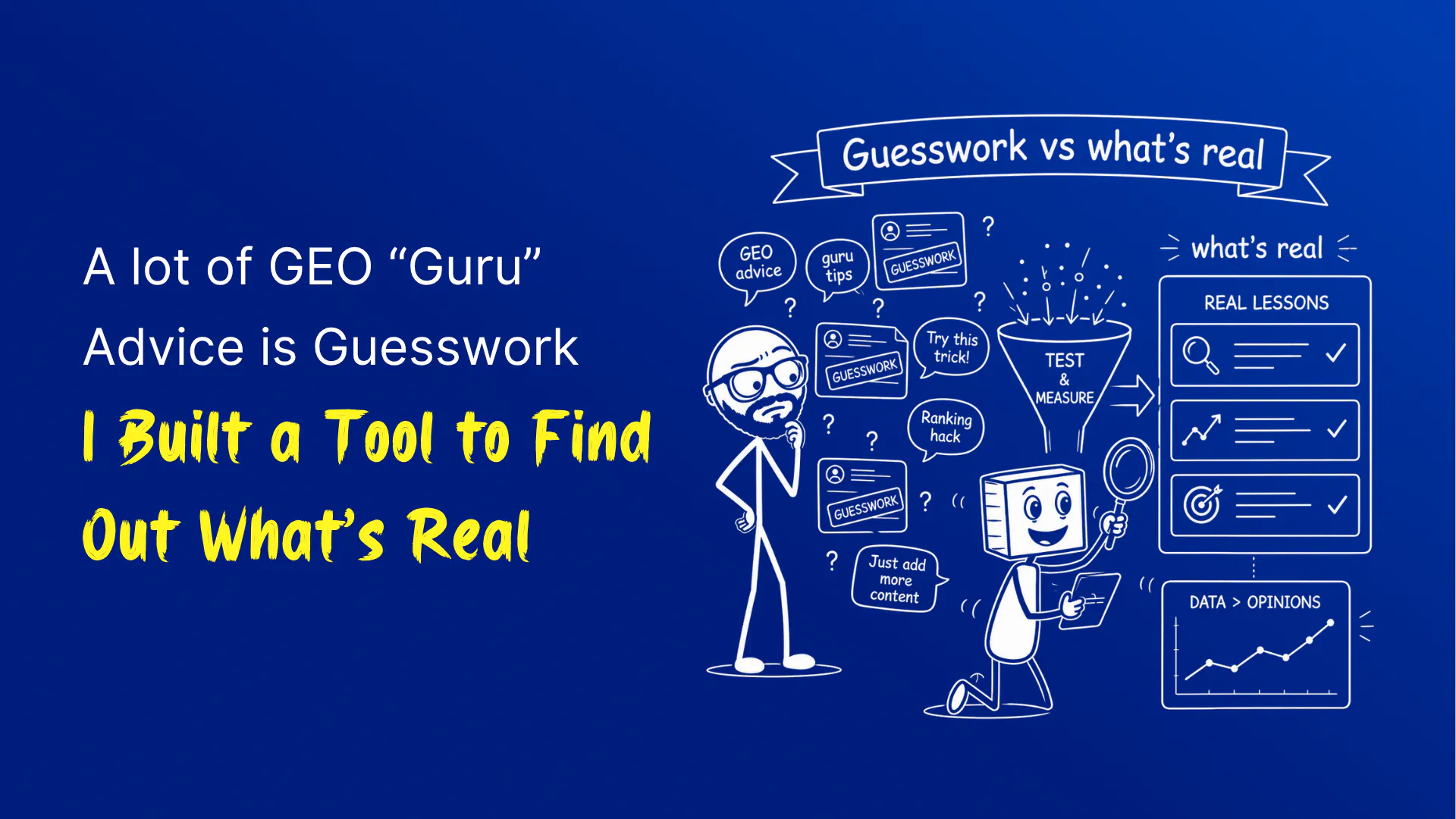
I've spent the last couple of months building a tool with AI, and it's taught me more about how these models work when scraping your employer brand content (GEO) than any amount of reading could have.
It's the latest of a handful of things I've built this way, most of which live on my resources page. The lessons are worth sharing, because the machines that judge you as an employer are now forming candidates' first impressions of you.
The tool is called TalentTell, and I built it to do one thing well - read how a company talks about itself to candidates and tell them, honestly, whether they stand out or blend in.
Lesson one: AI's need to find, read and interpret
The first real lesson it taught me was the first, figurative, painful jabs to my mush. When AI reads a company, it doesn't land on the same interpretation twice. That's the sort of thing you only learn by building the thing yourself.
Open LinkedIn on any given day and someone is telling you how to win at GEO - Generative Engine Optimisation. Not that I'm a sceptic, but it is LinkedIn after all (🤨), so I fear a good number of these "gurus" are regurgitatorians - repackaging something they read elsewhere, passing it off as their own "thought leadership," (🤨) with the primary aim of chasing personal engagement rather than actually wanting to help the community. Most will tell you GEO matters - to which a lot of us now think, "no shit, Sherlock." Very few will tell you what to do about it, so I'm keen to go against that grain.
What you're up against is more than one thing. First, a machine has to discover your content. Second, it has to be able to read it. Third, you need it to describe you the way you'd want to anyone who asks. Three things have to go right, and as I've learnt the hard way, getting them to work together is a ball-achingly frustrating game of AI whack-a-mole. 😫
What I was trying to build
The idea behind TalentTell is simple. Paste in your careers site, and it reads what you say about working there - your culture pages, your values, your job adverts - and scores how specific and distinctive that content really is. Then it plots you against real companies and hands you a communication character - the personality your writing gives off, whether you meant it to or not.
Why bother? Because the first thing a candidate learns about you increasingly doesn't come from you and your owned employer brand artefacts. It comes from an AI summary, a "what's it like to work at X?" answer generated in seconds. And an AI can only reflect back the content it can access, read and interpret. Specific content gives it something real; generic content gets you the forgettable average.
Standing out to a person and standing out to a machine have become the same problem.
So I built a machine that does the reading. And it was far harder than I expected.
Several weeks ago I ran one company through TalentTell, to see what an AI makes of their employer brand. Then, to check it, I ran the same company again. Same website, same content, same week. Nothing of what it was scraping had changed. It came back with a different answer. So I ran it a third time, and a fourth. Four runs, four reads that didn't line up. Warm and inclusive on one pass. Restless and pioneering on the next. A steady, wise authority on a third.
Enjoying this? I can pop the next one in your inbox if you'd like.
Lesson two: it reads you, but not the same way twice
The flip-flopping I've just described is because AI models are probabilistic, not deterministic. If you've never heard those terms, or you've heard them but aren't sure what they really mean, I'd strongly urge you to get to grips with them.
In this context, it means they don't look up a fixed answer and return it (like binary 1s and 0s code). They review what they can find and form an answer from what they discover, and the way they interpret that discovery can change every time. That's the roll of the dice (probabilism) baked into every response.
Early on I could dampen that. The model I started with had a setting called temperature, a dial for how much it improvises, and I could turn it to zero. When the models upgraded, that dial quietly disappeared. Either way, the honest truth is that identical output was never guaranteed.
So I stopped trying to make the AI behave and built a cage around it instead. TalentTell now takes a fingerprint of your exact content before it scores anything. Score the same content tomorrow and you get the same result, right down to the last point, because if the fingerprint matches, I don't ask the AI again. Same content, same score, every time.
The second jab took about four weeks of work before I even spotted it. I'd been scoring specificity and distinctiveness together, and the model kept quietly assuming that specific meant distinctive. It doesn't. You can pack a page with concrete detail and deliver it in a tone so bland nobody remembers a word of it. You can also have a cracking, ownable voice that says absolutely nothing. They're two different things, and letting them bleed together was making the scores lie. So I ripped the scoring out and rebuilt it, judging specificity and distinctiveness in completely separate passes, each blind to the other. The rebuild was painful. But it's the only way to stop one half of the equation quietly contaminating the other. The reliability doesn't come from trusting the model. It comes from refusing to.
Lesson three: getting to your words is half the fight
If the first two were jabs, this one was a hook, and it cost me weeks. Before the AI can judge your content, something has to go and fetch it. And unbeknownst to me, the web fights back.
Your job adverts are some of the most engaged with, revealing content you publish, and they're also the most likely to be invisible. Most employers post roles through a hiring system, and those systems don't behave the same way. Some hand over clean, readable job data through the front door. Others hide it behind configuration a machine can't open. A few of the biggest render everything in a way that looks perfect to a human and returns gibberish to a machine. One platform gave me over 10,000 words of styling code and not a single line of the actual job. Others sat behind a security gate serving nothing but a "prove you're human" message.
And when a page does load, the machine can't instinctively tell your employer voice from your sites's furniture. A careers page is culture copy wrapped in cookie notices, navigation menus, legal boilerplate, and, my personal favourite, the bits of template nobody filled in. I have watched pages serve up "Your engaging subtitle goes here" as though it were carefully chosen messaging. If you don't make it obvious what's real, the machine can quietly file your cookie banner under "how this company describes working here".
Lesson three: I rebuilt the scoring seven times
This was one of the uppercuts I wish I'd dodged, and it's the part I'm probably least proud of but learned the most from. Getting the AI to score consistently was one battle. Getting it to score correctly was a much longer one.
An early version was too soft. Everything came out looking pretty good, which helps nobody. So I made it harsher. That version overcorrected so badly it collapsed almost every company I tested into the same gloomy corner of the map, including one with a genuinely rich, distinctive careers site that any reasonable person would rate highly. A tool that says everyone is average is exactly as useless as one that says everyone is brilliant.
That was another back-to-the-drawing-board moment. Seven versions of the scoring engine in, I finally landed on something that held up. Instead of asking the AI for a vague verdict, I gave it evidence-anchored bands - clear descriptions of what a 40 looks like against a 70, and made it quote the exact words from your content that justify the score. I gave it fixed reference examples so it couldn't drift. And, most importantly, I stopped trusting my own gut on whether it was right.
I built what I call a gold set - a handful of companies I'd judged carefully by hand, with the answer I expected written down in advance. Every time I changed the scoring, the tool had to reproduce those answers before I'd ship it. Calibration went from a feeling to a pass-or-fail test. When the final version put every one of them exactly where it belonged, I signed it off. Not because it felt right, but because it had proved it.
The report I'm genuinely proud of
At the risk of stretching this post's boxing analogy to within an inch of its life - building this was a fight I wasn't expecting, and I've come out of it with a bloody nose and a bit of swelling around the eyes. But I'm extremely proud of what comes out the other end. It isn't a number and a shrug. It's a proper read on how you come across.
Is there room for improvement? Absolutely. That's where I'll lean on my community - if you use it and something doesn't sit right, tell me.
In the meantime, you get scored across five dimensions: specificity, distinctiveness, tone authenticity, human warmth, and whether the wrong candidate would sensibly rule themselves out. You get plotted on a map with four honest quadrants, from the Communication Cloner who sounds like everyone else to the Standout who is both specific and distinctive. You get your communication character, and where your content genuinely straddles two, it says so rather than forcing a false verdict.
And it shows its working. For every score, you can see the pages it read and the reasoning behind the number. Think of it like a Michelin Star inspector. Nobody asks a them for inter-rater reliability coefficients or margin-of-error bars on their star ratings. Instead, they have a clear framework, they apply it consistently to every restaurant, and they explain their reasoning.
TalentTell works the same way - the same dimensions, the same proportion-based scoring, the same cliché detection, applied identically to every company and explained openly. It's structured expert judgement at scale, not an oracle handing down a verdict you can't question, and not a lab result dressed up as physics. You can read the full methodology if you want the detail.
What this means for your own content
The tool doesn't just grade you. It gives you examples of sentences to fix. From there, you can get into the rhythm of what needs improving and make further updates across your site and your job ads.
Be specific. Most employer brand content leans on adjectives: "passionate team", "collaborative environment", "fast-paced culture". Those are claims, and a machine has learned to see straight through them. Swap them for evidence. "We offer flexible working" is a claim. "We work a four-day week with no cut to salary" is evidence. Named programmes, real numbers, specific behaviours: that is what a probabilistic reader can actually hold onto, and it is what a human remembers too.
Be distinctive. For every sentence, ask whether it could sit word-for-word on a competitor's careers page. "We value diversity" could belong to anyone. The things that are genuinely yours come from the choices and trade-offs only you have made - the odd rituals, the things you have decided not to be. Distinctiveness isn't a better adjective. It's a real detail.
Then say the same thing everywhere. Your careers site, your job adverts, your LinkedIn. If they tell one coherent story, that story gets sharper every time a candidate, or a machine, runs into it. If they contradict each other, you get averaged into 'meh' 🫤 🤷♂️, which is exactly how I ended up with a different company on every run.
What the whole thing taught me
Building TalentTell taught me that AI is incredibly powerful, but it is not remotely magic.
Left alone, it guesses, drifts, and will cheerfully tell you your cookie banner is your culture.
It takes 'bullshitting with confidence' to a whole new level.
Anchored, tested against answers you already trust, and made to show its working, it becomes something you can rely on. That's true of the tool I built, and just as true of every AI now forming an opinion about your organisation whether you like it or not.
If you want to see what yours says about you, TalentTell is free to use. And if you are curious about the other things I have been building with AI over the last couple of years, including the Talent Palette, they are gathered on my resources page.
The machines' understanding of you is only ever as good as the house you let it walk through. Go and see what it makes of yours.
Like what you're reading?
If my content resonates with you, I can deliver it to your inbox whenever I publish something new. No fluff and definitely no spam.


