
AI Compresses the Doing, Not the Decision by Committee.
Gallup's 2026 State of the Global Workplace report states that 65% of American workers in companies that have rolled out AI say it's had a positive impact on their productivity. Only 7% say it's made things worse.
Yet in the next breath, the same report says 89% of nearly 6,000 executives report no impact whatsoever on their company's labour productivity over the last 3 years. Also, an MIT study found that, despite roughly $40 billion of enterprise investment, 95% of organisations say they've seen zero measurable impact on profits.
Employees are saying they're experiencing improvements to productivity. Business school teaches us that improved productivity often leads to better profitability. Yet 89% of 6,000 executives aren't seeing any returns.
It made me think about why that was, so here's my $0.02's worth.
Everyone's using it. So where's the return?
Companies are handing out licences, running the training sessions, and in some cases actively pushing people to use the tools. Then they're watching the token bills climb and wondering where the return is.
The people have the tools. The people are using the tools. The people even like the tools. But in larger organisations, the commercial benefit still isn't landing.
This is what baffles me. As someone using AI prolifically in my business, where I can see and feel the return every single day, I ask myself - if you had a thousand people in one organisation using it the way I use it in mine, how can they not be seeing additional revenue and profit?!
It reminds me of when social media properly ramped up around 2008-2010. Two things happened at once. Legal, Compliance and Data teams got extremely cautious, whilst others got extremely excited and adopted a "Ready!.. Fire!.. Aim!" approach.
I was working in retail and hospitality at the time, and we had stores and restaurants spinning up their own Facebook pages, throwing out any old content on them with no clear objectives. Once the initial excitement died down it very quickly became extra work for somebody who wasn't being measured on or rewarded for it. As rapidly as those pages sprung up, they went dormant - with their crap content and zero community management quietly damaging their brands. Then someone had to come along later and do a massive audit to clean up the mess, closing pages down whilst managing internal politics the accounts' communities in the process.
I think we're seeing something similar with AI. Companies are getting excited and saying to their people, "Go and use it." The gap is that nobody is saying where, how, or why.
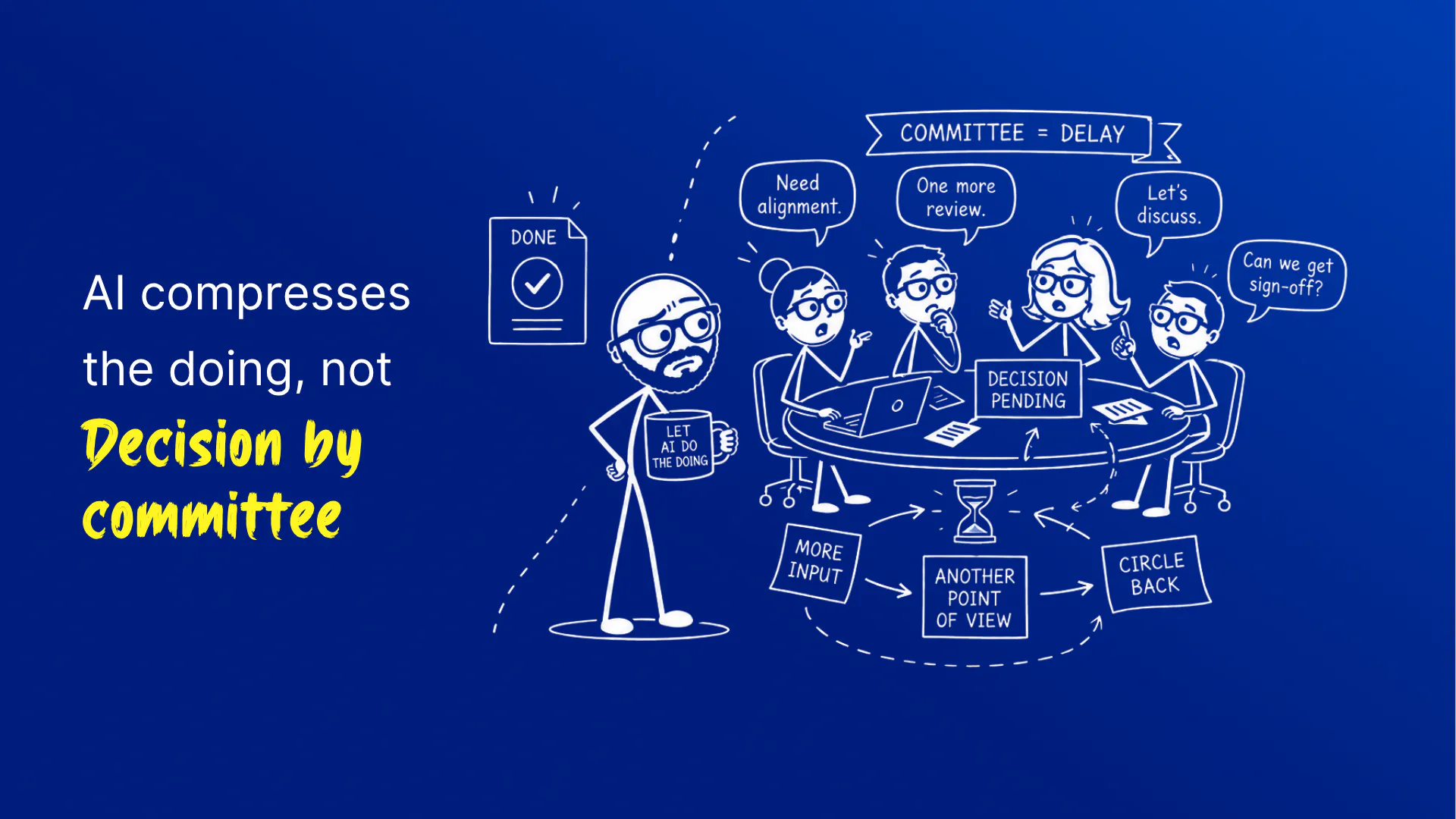
AI compresses the doing. It doesn't compress the committee deciding.
I think there's another part to to why larger companies aren't seeing the returns they should be seeing based off of their employees using the tools.
Before AI came along there would have been many instances where big businesses were probably never inefficient because of the work itself. They were slow because of permission. Because of alignment. Because of sign-off... Other people's calendars... The eight people who need to have seen it first... And the committee that meets once a month when the moon is in it's Waxing Crescent phase!
AI is extraordinary at compressing the doing. The work that may have already been quite efficient is now incredibly more so - the research, the drafting, the analysis, the building, the actual production of work. But - and it's a big but - its probably done almost nothing to compress the deciding.
You can put a bigger engine in every car on the road. Everybody still queues at the same width restriction, and the width restriction still only lets one car through at a time.
| So if your bottleneck was never execution speed, giving everyone faster production changes remarkably little. The work arrives at the queue quicker. The queue is still the queue. That, I think, is a big part of the gap between 65% and 89%. |
A Miro board full of post-its
I'm supporting a client at the moment with their talent transformation, looking at how they apply AI across their end-to-end attraction and hiring process.
I led a workshop with their TA leads, where we pulled the whole thing apart. Ten steps, from the moment a role is approved to the moment someone signs. At every single step, one instruction - get every frustration, every blocker, every bit of friction that slows this down onto a post-it and stick it on the board.
The board filled up quickly (they always do!)
Then we did the revealing bit, which was going through every post-it and sorting them into three buckets.
- People. Behavioural. Somebody isn't doing the thing, or is doing it late, or is doing it differently to everyone else.
- Process. The way the work is designed, sequenced, governed or handed over.
- Platform. The technology. The ATS, the CRM, the tooling. And now, AI.
Guess which bucket won.
The majority of the weak links in the chain were down to people and process. Platform had the fewest votes by volume - although, to be fair to the room, when we weighed the frustrations by severity rather than just counting them, there was one platform in their stack causing major issues through its lack of required features and functionality. So it's rarely as clean as "the tech is fine." But the pattern was unmistakable.
What became clear very quickly, and as is always the case, is that technology is never the silver bullet (cue the audible groans of 'no shit, Sherlock!') What we got was clarity around something we probably already knew.
Say we eventually get to a world where AI can shortlist CVs properly - reliably, ethically, consistently, without introducing biases. Brilliant. The shortlist now lands on the hiring manager's desk in 4 minutes as opposed to 4 days. And then the hiring manager sits on it for 2 weeks.
No amount of AI fixes that. That's a behavioural problem. If you buy a platform hoping it will solve the behaviour, you've just bought a faster car for a driver who won't leave their house.
If you're going to take anything from this post, take the process mapping and sorting exercise. Before you buy the platform, you need to spot the weakest links in the chain, and then you need to get to the root cause of their frailties. Is it the way people behave? Is it a process? Is it a platform? Or is it a combination of two or three of these? Then you count how many of them the platform can actually touch, and specifically, what AI can improve.
Enjoying this? I can pop the next one in your inbox if you'd like.
The missing ingredient is strategy, not licences
This is also where I think the 89% actually comes from.
In some of the organisations I work with, there's no real strategy sitting underneath the AI rollout. There's a budget, there's a vendor, there's a mandate to "adopt AI", and there's a lot of genuine individual enthusiasm. What there isn't is a plan connecting any of it to a commercial, cultural or operational outcome (well - maybe there's a 'be faster and better!')
And the fix isn't complicated. It's strategy 101.
- Understand where you are.
- Understand where you want to be.
- Agree what you're going to do.
- Agree what you're NOT going to do. (which is equally important to the point above and the bit a lot of people miss).
- Figure out how you're going to use AI to get there.
That's what the workshop was. Step one. You can't work out what AI should do for your hiring process until you know, at a granular level, where your process actually hurts and why. Putting AI on a crap process is a crap process just extrapolated.
Where they want to be, in this client's case, is a team that can be more strategic, more consultative, less transactional - and clearer on how they're impacting the business. Not just commercially, by reducing costs. Culturally, by bringing in the right people - culture enhancers, not degraders. And operationally - with better hires, ramping up to productivity sooner and finding ways to improve how the business functions overall.
An increase in AI adoption, in plenty of places, results in a decrease in human headcount. For this particular client, that was not the project's MO. It's about freeing up the time to be more strategic, more consultative, less transactional, and to provide a better service.
Which brings me on to Rory Sutherland.
The finance department and the doorman
I've been noticing Rory Sutherland talking about this a lot recently and, as usual, articulating it far better than I ever could.
His line is that there are two people he doesn't want getting their hands on AI. Terrorists, and the finance department.
His reasoning is that what happens with AI will be a product of the frame in which it gets applied. And the easiest way to sell anything into a large company is usually cost savings, by reducing the number of people on the payroll. The correct mentality, as he puts it, is asking what we can do with this that we couldn't do before. An exploration mindset. But the efficiency mindset is so dominant in any quarterly-reporting, shareholder-led business that short-term cost savings will probably always trump long-term opportunity.
I think this is the nub of it. My assumption is that the reason these execs are saying they're not seeing a return is that they're only looking at it through a financial lens - and, to make it worse, that's financial efficiency, not necessarily operational efficiency. It comes with the question "how can we use this to cut costs?" as opposed to "how can we use this for exploration, for creativity, to do something bolder?" One is about reduction. The other is about expansion.
He also uses an idea worth keeping in your back pocket, called the doorman fallacy. Picture the doorman at the Ritz in London. Not a bouncer - the person who welcomes you. Automate him, and the spreadsheet faithfully records the salary you've saved. What it doesn't record is everything else he was quietly doing that nobody ever measured:
- the greeting
- the human warmth
- making guests feel seen, recognised and cared for
- the reassurance
- the security presence
- the judgement about who looked wrong
You don't just remove a cost. You remove a cost and an unmeasured benefit - one that was quietly feeding income elsewhere, that can't be tracked and can't be attributed to the doorman, but that he was obviously influencing.
We already know what this feels like, because we've lived a version of it for years - chatbots and automated phone systems in customer service. Most of us hate them. If you're anything like me, you spend a couple of infuriating minutes smashing the relevant buttons on your keypad trying to bypass the robot and reach a human as quickly as possible. And sometimes, when that option is buried deep enough, I'll simply refuse to do business with that provider. The spreadsheet recorded the saved salaries. It never recorded me walking away.
Where I part company with Rory is on timing. He reckons this will take about ten years to shake out. I think it will be more like 3 to 5. But his underlying point stands either way - we don't fully know how this is going to work yet, which is itself a good reason not to be hasty about getting rid of people.
Why this lands on People and Culture's desk, not IT's
Cutting people for savings that never materialise doesn't just waste money. It probably spends the exact thing you needed in order to do the interesting version later.
A figure I've seen is that 39% of business leaders have already made people redundant as a result of deploying AI, and 55% of those admit the decision was wrong.
Every one of those wrong decisions probably taught the people who stayed one lesson. And it's not a lesson about productivity. It's that, in those scenarios, this technology is the mechanism by which colleagues disappear.
Then, 18 months later, somebody sends a company-wide email asking everyone to get curious about AI, experiment freely, and help us discover what we could do that we couldn't do before.
Good luck with that!
Because the exploration mindset Rory's describing runs entirely on discretionary effort. On curiosity, and psychological safety, and people being willing to try something that might not work in front of their colleagues. You cannot mandate it, you cannot buy it, and you certainly cannot get it from a workforce you've just taught that curiosity about AI is how people get walked out.
The efficiency frame doesn't merely miss the opportunity frame. My assumption is that it shuts the door on it. You probably can't do part one badly and then move cleanly to part three, because part one damages the raw ingredients part three feeds on.
| What makes this an EVP problem, not an IT problem, is that it's about what you're promising people, whether they believe you, and whether there's enough trust in the building for anyone to risk trying something new. |
The productivity gains may well come. Rory thinks a decade. I'm putting my chips on 3 to 5 years. But I suspect the companies that get there won't be the ones that moved fastest to cut. They'll be the ones that spent this period fixing the people and the processes, so that when the platform finally is the bottleneck, they've got something better than a very fast shortlist sitting in a hiring manager's inbox for a fortnight.
Like what you're reading?
If my content resonates with you, I can deliver it to your inbox whenever I publish something new. No fluff and definitely no spam.


